SSDI vs. SSI: Disability Benefits Explained and Which Is Right for You
Disability Benefits Explained: SSDI vs. SSI and Which One Is Right for You
If you’re trying to understand disability benefits in the United States, the two programs that come up most often are SSDI and SSI. They sound similar, and both are administered by the Social Security Administration, but they serve different purposes and have very different rules. Choosing the right path matters because the application process, eligibility requirements, and monthly payments can all change depending on which program applies to your situation.
This guide breaks down SSDI vs. SSI in plain English so you can see how each one works, who qualifies, and how to figure out which disability benefits may be right for you.
What Are Disability Benefits?
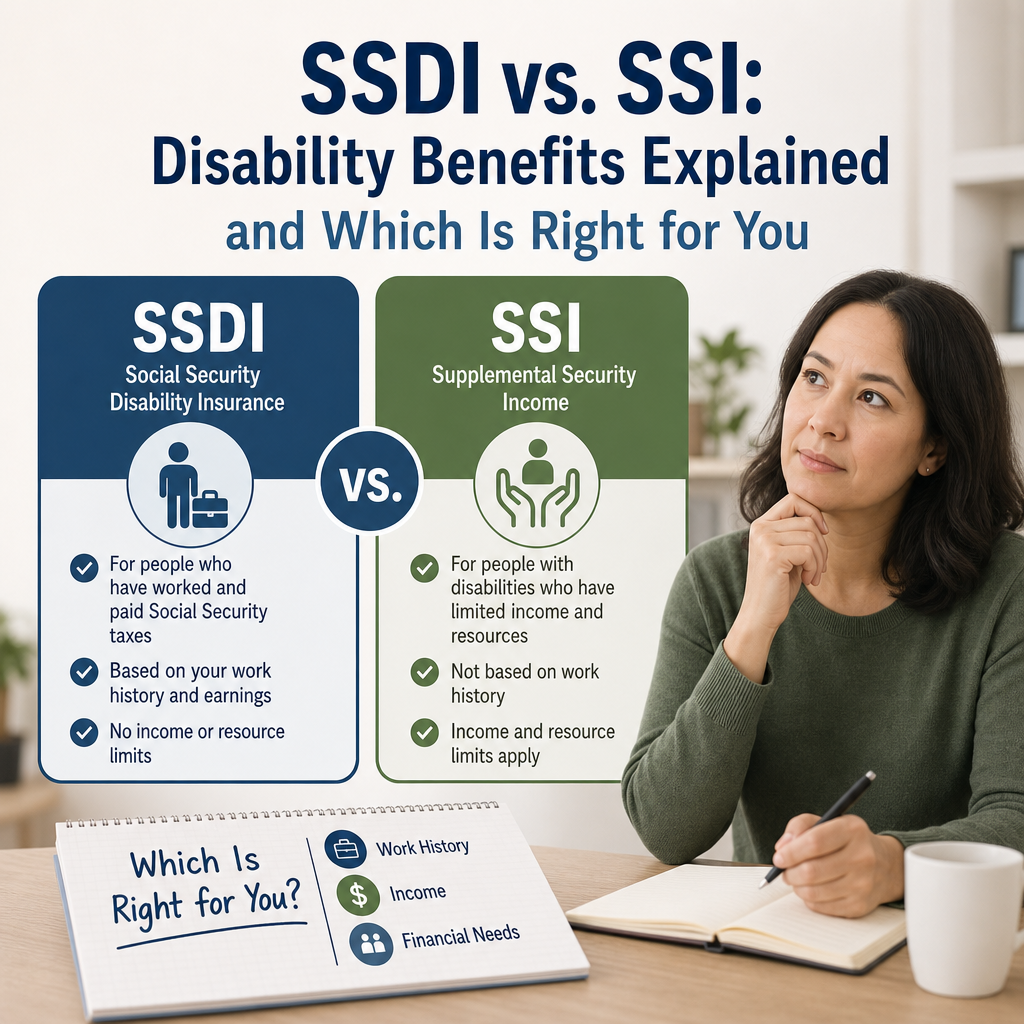
Disability benefits are government programs that provide financial support to people who cannot work because of a qualifying medical condition. In the Social Security system, the two main disability benefits programs are:
- Social Security Disability Insurance (SSDI)
- Supplemental Security Income (SSI)
Although both programs use the Social Security Administration’s disability standards, they are not the same. One is based on your work history and payroll tax contributions, while the other is based mainly on financial need.
SSDI vs. SSI: The Core Difference
The easiest way to think about SSDI vs. SSI is this:
- SSDI is for people who have worked and paid Social Security taxes long enough to earn coverage.
- SSI is for people with limited income and resources, whether or not they have a work history.
SSDI in a nutshell
SSDI is an earned benefit. If you worked in jobs where you paid Social Security taxes, you may have built up the work credits needed to qualify. The amount you may receive is generally tied to your past earnings.
SSI in a nutshell
SSI is a needs-based program. It does not require a work history. Instead, the Social Security Administration looks at your income, resources, and living situation to decide whether you qualify.
How SSDI Works
SSDI is designed for workers who became disabled after paying into Social Security.
Basic eligibility for SSDI
To qualify, you typically must:
- Have a medical condition that meets Social Security’s definition of disability.
- Have enough work credits from jobs covered by Social Security.
- Be unable to engage in substantial gainful activity because of your condition.
- Have a disability expected to last at least one year or result in death.
Work credits and SSDI
Work credits are earned based on wages or self-employment income that is subject to Social Security tax. The number of credits needed depends on your age when your disability begins. In general, the younger you are, the fewer credits you may need.
How SSDI payments are calculated
SSDI benefits are based on your average lifetime earnings before your disability began. Higher past earnings often lead to higher monthly payments, though the exact amount depends on your work record.
Medicare and SSDI
A major feature of SSDI is that recipients may become eligible for Medicare after a waiting period. That can be especially important for people with ongoing medical needs.
How SSI Works
SSI provides monthly payments to people who are disabled, blind, or age 65 and older, if they meet income and resource limits.
Basic eligibility for SSI
To qualify, you generally must:
- Be disabled, blind, or age 65 or older.
- Have limited income.
- Have limited resources.
- Be a U.S. citizen or meet certain qualified noncitizen rules.
- Live in one of the 50 states, D.C., or the Northern Mariana Islands, in most cases.
Income and resource rules for SSI
SSI looks closely at your financial situation. Resources may include:
- Cash
- Bank accounts
- Stocks and bonds
- Some property beyond your primary home
Not everything counts. For example, the home you live in and one vehicle may be excluded in many cases. Income also matters, and the Social Security Administration applies rules about wages, support from others, and other types of payments.
How SSI payments are calculated
SSI payments are reduced based on countable income. Because it is a needs-based program, the monthly benefit amount can vary depending on your financial circumstances and state rules.
Medicaid and SSI
In many states, SSI recipients automatically qualify for Medicaid or are made eligible through a related process. That can make SSI especially valuable for people who need access to affordable health coverage.
Key Differences Between SSDI and SSI
Understanding SSDI vs. SSI becomes easier when you compare them side by side.
1. Work history
- SSDI: Requires work credits
- SSI: Does not require work credits
2. Financial eligibility
- SSDI: No strict asset limit for the disability benefit itself
- SSI: Strict income and resource limits
3. Benefit amount
- SSDI: Based on your past earnings
- SSI: Based on federal benefit rates and reduced by countable income
4. Health coverage
- SSDI: May lead to Medicare eligibility after a waiting period
- SSI: Often linked to Medicaid eligibility, depending on the state
5. Who it is for
- SSDI: Workers who paid into Social Security
- SSI: People with limited income and resources, including those with little or no work history
Can You Qualify for Both SSDI and SSI?
Yes, some people qualify for both SSDI and SSI at the same time. This is often called concurrent benefits.
That can happen when:
- You have enough work credits to qualify for SSDI
- But your SSDI payment is low enough that you still meet SSI financial limits
For example, if your past earnings were modest and your SSDI payment is small, SSI may help fill the gap. This combination can be especially useful because it may provide both income support and access to healthcare coverage depending on your circumstances.
Which Disability Benefit Is Right for You?
Choosing between SSDI vs. SSI depends mainly on your work history and your current financial situation.
SSDI may be the better fit if:
- You worked enough years to earn work credits
- You paid Social Security taxes
- Your income and assets are not the main issue
- You need a benefit tied to your earnings record
SSI may be the better fit if:
- You have little or no work history
- Your income and resources are limited
- You are disabled, blind, or age 65 or older
- You need a needs-based benefit
You may qualify for both if:
- You worked enough for SSDI
- Your monthly SSDI benefit is low
- You meet SSI’s income and asset limits
How Social Security Defines Disability
For both SSDI and SSI, Social Security uses the same basic disability standard.
The disability standard
Your condition must:
- Prevent you from doing substantial work
- Be expected to last at least 12 months or result in death
- Be severe enough to meet Social Security’s criteria
This standard is strict. Social Security does not approve claims simply because you have a diagnosis. It focuses on how your condition affects your ability to work.
What Social Security looks at
The agency reviews:
- Medical records
- Lab results
- Doctor statements
- Treatment history
- Work history
- Functional limitations
That means strong documentation is critical. A detailed medical record often makes the difference in a disability claim.
Common Medical Conditions That May Qualify
Many physical and mental health conditions can qualify if they are severe enough to limit work ability and meet the program’s standards. Examples include:
- Severe back disorders
- Heart disease
- Cancer
- Chronic respiratory conditions
- Neurological disorders
- Advanced arthritis
- Major depression
- Bipolar disorder
- Schizophrenia
- Autism spectrum disorder
- Traumatic brain injury
A diagnosis alone is not enough. The condition must significantly interfere with your ability to perform substantial work.
Applying for Disability Benefits
The application process for SSDI and SSI is similar, but the financial questions differ.
What you’ll need
It helps to gather:
- Personal identification information
- Social Security number
- Medical records and provider information
- Work history
- Income and asset information
- Banking information for direct deposit
- Medication and treatment details
Where to apply
You can apply:
- Online through the Social Security Administration
- By phone
- In person at a local Social Security office
Helpful tips for the application
- Be honest and specific about your symptoms
- Describe how your condition affects daily activities and work
- Include all treatment sources
- Don’t leave out part-time work, side jobs, or limited work attempts
- Respond quickly to any requests for additional information
What If Your Claim Is Denied?
Many disability claims are denied at first, and that does not necessarily mean you are not eligible. Denials often happen because of missing records, incomplete forms, or a finding that the condition is not severe enough under Social Security rules.
If your claim is denied, you can:
- Review the denial letter carefully.
- Note the deadline to appeal.
- Submit an appeal on time.
- Add stronger medical evidence if available.
- Consider getting help from an attorney or advocate familiar with disability claims.
Appeals matter because many applicants are approved later in the process after supplying better documentation.
Practical Examples of SSDI vs. SSI
Example 1: A longtime worker with a serious injury
A factory worker who paid Social Security taxes for 20 years suffers a severe spinal injury that prevents full-time work. Because of the work history, SSDI may be the right benefit.
Example 2: A young adult with limited work history
A 24-year-old with a severe mental health condition has not worked enough to earn SSDI coverage and has very limited income and savings. SSI may be the better fit.
Example 3: A low-wage worker with modest benefits
A retail worker qualifies for SSDI but receives a small monthly amount because of lower lifetime earnings. The worker may also qualify for SSI if income and resource rules are met.

How to Decide Your Next Step
If you are unsure which disability benefits program fits your case, start with these questions:
- Did I work long enough to earn Social Security work credits?
- Did I pay Social Security taxes through my job?
- Is my income currently very limited?
- Do I have very few resources?
- Is my condition severe enough to keep me from working full time?
If the answer to the work-history questions is yes, SSDI may apply. If the answer to the financial-need questions is yes, SSI may apply. If both sets of answers seem to fit, you may want to explore whether you can receive concurrent benefits.
Frequently Asked Questions
1. What is the main difference between SSDI and SSI?
The main difference is that SSDI is based on work history and Social Security tax contributions, while SSI is based on financial need. SSDI rewards prior work, whereas SSI supports people with limited income and resources, including those with little or no work history.
2. Can I get SSDI if I have never worked?
Usually, no. SSDI generally requires enough work credits earned through jobs where you paid Social Security taxes. If you have never worked or do not have enough credits, you may still qualify for SSI if you meet the disability and financial requirements.
3. Does SSI automatically mean I get Medicaid?
In many states, SSI recipients qualify for Medicaid, but the rules can vary by state. Some states link Medicaid eligibility directly to SSI, while others use different procedures. It’s important to check your state’s rules.
4. How long do I have to wait for SSDI benefits?
SSDI has a five-month waiting period before cash benefits typically begin, counted from the time your disability starts, not from the date you apply. Some people may also have to wait longer for Medicare eligibility. SSI does not have the same waiting period, though application processing time still applies.
5. Can I work and still receive disability benefits?
Possibly. Both SSDI and SSI have rules that may allow some work activity, especially if your earnings stay below certain limits. Social Security also has programs that encourage people to try working without immediately losing benefits. Because the rules are different for each program, it’s important to report any work activity accurately.
Official Resources
- Social Security Administration: Disability Benefits
- Social Security Administration: Supplemental Security Income (SSI)
- Social Security Administration: Apply for Disability
- Medicare.gov: Eligibility and Enrollment
- Benefits.gov: Disability Assistance
Conclusion
Understanding disability benefits can feel overwhelming at first, especially when you are comparing SSDI vs. SSI and trying to figure out which program fits your situation. The good news is that the distinction becomes clearer once you focus on two key questions: Did you work and pay into Social Security, or do you mainly need a needs-based benefit because your income and resources are limited? SSDI serves workers who earned coverage through their jobs, while SSI helps people with limited financial means, including those with little or no work history.
If you think you may qualify, the next step is to gather your medical records, work history, and financial information, then review the Social Security requirements carefully. A strong application is built on clear evidence, consistent treatment history, and an accurate picture of how your condition affects your ability to work. Whether you apply for SSDI, SSI, or both, taking the time to understand the rules can help you move forward with more confidence and avoid common mistakes.