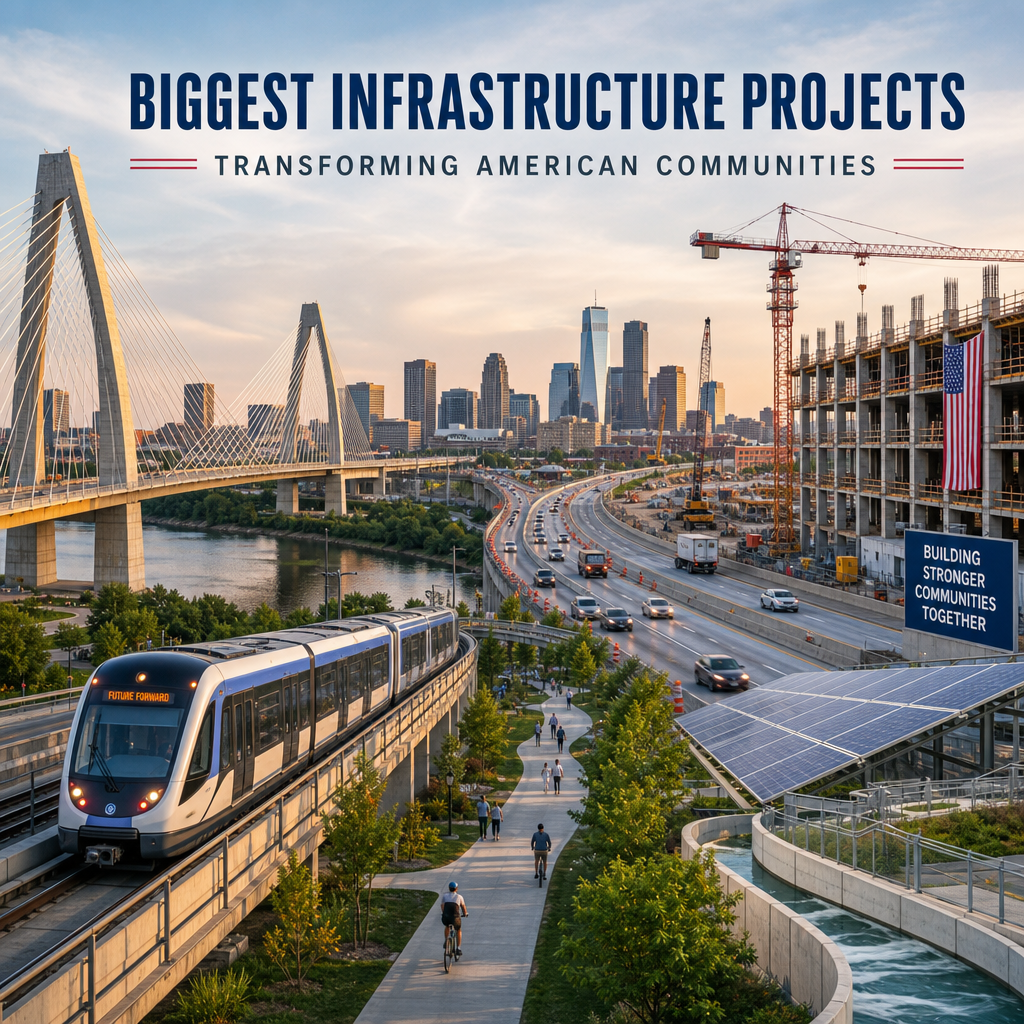
Biggest Infrastructure Projects Transforming American Communities
From bridge replacements and transit upgrades to clean water and broadband expansion, infrastructure projects are changing how American communities move, connect, and grow. These investments are improving daily life today while building safer, stronger neighborhoods for the future.
By: Peter B on July 25, 2026
American infrastructure is in a period of visible change. Across the country, the biggest infrastructure projects transforming American communities are reshaping how people travel, access clean water, move goods, connect to broadband, and prepare for extreme weather. These projects are not just about concrete and steel. They influence daily life, local economies, public safety, and long-term community resilience.
From modernized transit systems to bridge replacements, water system upgrades, and broadband expansion, infrastructure investment affects nearly every part of American life. In many communities, these projects are correcting decades of underinvestment while creating the foundation for future growth.
Why infrastructure matters for everyday life
Infrastructure is easy to overlook when it works well. When it fails, people notice immediately.
A reliable bridge shortens commutes and keeps supply chains moving. A modern water system protects public health. Expanded broadband gives students, workers, and small businesses more opportunity. Strong infrastructure also helps communities respond to storms, heat waves, floods, and other climate-related risks.
The biggest infrastructure projects transforming American communities usually share a few goals:
Improve safety and reliability
Reduce long-term maintenance costs
Support economic growth
Expand access to essential services
Build resilience for future conditions
Because these projects are so interconnected, they often produce benefits beyond their original purpose.
The biggest infrastructure projects transforming American communities
Large-scale infrastructure work takes many forms, but some categories are especially important right now. These are the areas where federal, state, and local investments are creating the most visible change.
1. Bridge repairs and replacements
Bridges are among the most critical parts of the transportation network. Many older bridges were designed for traffic volumes and vehicle weights far lower than what they carry today. When a bridge is in poor condition, the effects ripple outward quickly.
Bridge replacement and rehabilitation projects can:
Reduce the risk of closures and detours
Improve freight movement
Make travel safer for drivers, cyclists, and pedestrians
Restore connectivity between neighborhoods and towns
A practical example is a rural community where a single bridge connects farms, schools, and emergency services to the nearest highway. If that bridge is restricted, local businesses lose time and money, and emergency response can slow down. Replacing it has a direct effect on quality of life.
Many bridge projects also include updated lane design, stronger railings, better lighting, and pedestrian access. That makes them more than simple repairs; they become multi-use safety upgrades.
2. Transit system modernization
Transit investments are changing how people move in urban and suburban areas. Modern rail systems, expanded bus networks, improved stations, and better signal coordination can make public transportation more reliable and more attractive.
Transit modernization projects often focus on:
Faster and more frequent service
Accessibility improvements for riders with disabilities
Better station design and safety features
Real-time information systems
Reduced congestion and emissions
In growing metro areas, transit upgrades can help workers reach jobs without adding more cars to already crowded roads. In smaller cities, bus rapid transit or improved local service can make essential trips more practical for people who do not drive.
Transit infrastructure can also support housing and downtown redevelopment. When a station area becomes easier to access, businesses often follow.
3. Water and wastewater upgrades
Clean water is one of the most basic public needs, yet many systems are aging. Some communities still rely on pipes, treatment plants, and pumping systems that are far past their intended service life. That can lead to leaks, service disruptions, contamination risks, or sewer overflows.
Water infrastructure projects often include:
Lead service line replacement
Treatment plant upgrades
Pipe repairs and replacements
Stormwater management improvements
Wastewater treatment expansion
These investments protect public health and support future development. A town cannot grow confidently if businesses and families worry about whether the water system can keep up.
A strong water system also helps with resilience. For example, upgraded stormwater infrastructure can reduce flooding after heavy rain. That matters for neighborhoods where basement flooding, road washouts, or sewer backups have been a recurring problem.
4. Broadband expansion
Broadband has become essential infrastructure for modern life. It affects education, telehealth, remote work, digital business, and emergency communication. Yet many rural and low-income communities still lack fast, reliable internet service.
Broadband infrastructure projects are transforming communities by:
Expanding access to high-speed internet
Supporting remote learning and job training
Improving access to healthcare services
Helping small businesses reach new customers
Reducing the digital divide
Fiber-optic buildouts are often the most durable long-term solution, though fixed wireless and other technologies can help bridge gaps in the short term. In many places, broadband investment is as important as roads and power lines because it determines whether people can fully participate in the economy.
For a student in a rural area, broadband can mean the difference between completing homework at home or driving to a library parking lot to find a signal. For a small business owner, it can mean the ability to process orders, manage payroll, and communicate with customers efficiently.
5. Airport and port improvements
Airports and seaports are vital to both regional economies and national commerce. These facilities help move people, goods, and raw materials efficiently. When they are modernized, the benefits extend far beyond the terminal or dock.
Major airport and port infrastructure projects may include:
Runway and taxiway upgrades
Terminal expansion and modernization
Cargo handling improvements
Road and rail access enhancements
Electrification and emissions reduction efforts
Ports in particular play an important role in supply chain reliability. Improvements to dock equipment, rail connections, and freight handling capacity can reduce bottlenecks and support local jobs. Airports benefit travelers, tourism, and business activity, especially when they are designed to handle future growth more efficiently.
6. Energy grid and utility modernization
The electric grid is one of the most important systems in the country, but it faces growing pressure from severe weather, higher demand, and aging equipment. Utility modernization projects are helping communities keep the lights on while preparing for a cleaner energy future.
These projects can involve:
Replacing aging transmission and distribution equipment
Installing smart grid technology
Improving storm resilience
Adding battery storage and backup systems
Supporting electric vehicle charging networks
A more resilient grid reduces outage risks and improves recovery after storms or wildfires. In some communities, utility upgrades also allow for greater use of distributed energy resources, such as rooftop solar and local storage.
For residents, the impact is straightforward: fewer outages, faster restoration, and better service reliability.
7. Road safety and corridor redesigns
Not every major project is a brand-new highway. Some of the most meaningful infrastructure work involves redesigning existing roads to better serve everyone who uses them.
Road safety projects may include:
Adding turn lanes and medians
Improving intersections
Creating safer sidewalks and crosswalks
Installing traffic calming features
Upgrading signage and lighting
These changes can reduce crashes and make streets more usable for pedestrians, cyclists, and drivers. In many communities, road redesigns are helping main streets become safer and more economically vibrant at the same time.
A corridor that once moved traffic quickly but discouraged walking may become a place where people can shop, dine, and gather. That shift supports local business while improving access to services.
What makes these projects so transformative?
The biggest infrastructure projects transforming American communities do more than fix problems. They change the conditions that shape growth, mobility, and opportunity.
They create long-term value
Infrastructure has a long lifespan, so smart design decisions can pay off for decades. A well-built bridge or upgraded water plant reduces repeated emergency repairs and lower-quality temporary fixes.
They strengthen local economies
Infrastructure supports jobs directly through construction and indirectly through better business conditions. Reliable roads, ports, broadband, and transit make it easier for employers to operate and expand.
They improve equity
Well-planned infrastructure can close gaps between neighborhoods and regions. Broadband expansion, accessible transit, and safer streets can help more people reach education, healthcare, and employment.
They build resilience
Communities are facing more intense weather events and aging systems. Infrastructure that is designed with resilience in mind can reduce damage, speed recovery, and keep essential services working during disruptions.
Challenges that can slow progress
Even promising infrastructure projects face real-world hurdles. Understanding those challenges helps explain why some projects take years to complete.
Permitting and approvals
Environmental review, land acquisition, and multi-agency coordination can slow timelines. These steps matter, but they can also create delays if not managed efficiently.
Funding gaps
Large projects often depend on a combination of federal, state, local, and private funding. If one source falls through, work may be scaled back or postponed.
Workforce shortages
Construction, engineering, utility, and technical labor shortages can affect schedules and costs. Communities that invest in workforce development are often better positioned to deliver projects successfully.
Community disruption
Even beneficial projects can create temporary inconvenience. Road closures, detours, noise, and service interruptions can frustrate residents and businesses. Clear communication helps build public support.
How communities can benefit most from infrastructure investment
Communities get the best results when infrastructure planning is practical, inclusive, and future-focused.
Key strategies include:
Prioritize high-impact projects
Focus on infrastructure that affects safety, access, and economic stability first.
Plan for maintenance, not just construction
New assets only stay useful if funding exists for long-term upkeep.
Engage residents early
Public input can help identify local needs and reduce resistance to change.
Coordinate across agencies
Aligning transit, road, water, and broadband work can prevent duplicate disruptions.
Build for the future
Projects should account for growth, climate risk, and evolving technology.
When communities take this approach, infrastructure becomes a strategic asset rather than a recurring emergency.
Examples of infrastructure impact in daily life
The value of infrastructure is easiest to understand through real-life outcomes.
A parent gets to work on time because a bridge repair eliminated a detour.
A student attends online classes from home because broadband reached a formerly unserved area.
A neighborhood avoids repeated flooding after stormwater improvements.
A downtown business district sees more foot traffic after safer streets and better transit access.
A hospital maintains reliable power during an outage thanks to grid improvements.
These changes may seem local, but collectively they shape the future of American communities.
Frequently Asked Questions
What are the biggest infrastructure projects transforming American communities?
They include major bridge repairs, transit modernization, water and wastewater upgrades, broadband expansion, airport and port improvements, energy grid modernization, and road safety redesigns. These projects improve daily life while supporting long-term economic and public health goals.
Why is broadband considered infrastructure?
Broadband is essential for work, school, healthcare, and communication. In many communities, especially rural areas, reliable internet access is as necessary as roads or utilities because it allows people to participate fully in modern life.
How do infrastructure projects help local economies?
They create construction jobs, improve access to markets, reduce transportation delays, attract new business investment, and make communities more attractive for residents and employers. Reliable infrastructure lowers operational friction for nearly every industry.
Why do so many infrastructure projects take a long time?
Large projects often require environmental review, engineering studies, permits, land acquisition, public input, and funding coordination. These steps are important for safety and accountability, but they can extend timelines significantly.
How can residents stay informed about local infrastructure projects?
Residents can monitor city and county websites, attend public meetings, sign up for agency alerts, and follow local transportation or utility departments. Community input periods are often the best time to ask questions and share concerns.
The biggest infrastructure projects transforming American communities are doing more than repairing what is broken. They are improving safety, strengthening local economies, expanding access to essential services, and preparing towns and cities for future challenges. Whether the project is a bridge replacement, a broadband expansion, a transit upgrade, or a water system overhaul, the underlying goal is the same: create a stronger, more reliable foundation for daily life.
These investments matter because infrastructure touches everything. It affects how people get to work, how children learn, how businesses grow, and how communities recover after storms or disruptions. The most successful projects are not just ambitious; they are thoughtful, durable, and responsive to real community needs.
As these projects continue across the country, residents, leaders, and local organizations all have a role to play in shaping outcomes. Staying informed, supporting long-term planning, and asking the right questions can help ensure that infrastructure delivers lasting value. In the end, well-designed infrastructure is not just about building for today. It is about creating communities that can thrive for decades to come.
Peter B holds a degree in Journalism and has 5 years of experience covering U.S. economic policy, labor markets, and financial news. He writes data-driven news content on topics like inflation, interest rates, and employment trends.