America in 2026: Economic, Social, and Infrastructure Trends
America in 2026 is a story of balancing innovation with everyday pressures, as new technologies, shifting work patterns, and affordability concerns reshape daily life. From the labor market to infrastructure, the forces driving change are closely connected and will influence the country’s future in big ways.
By: Peter B on July 25, 2026
America in 2026: Economic, Social, and Infrastructure Trends Explained
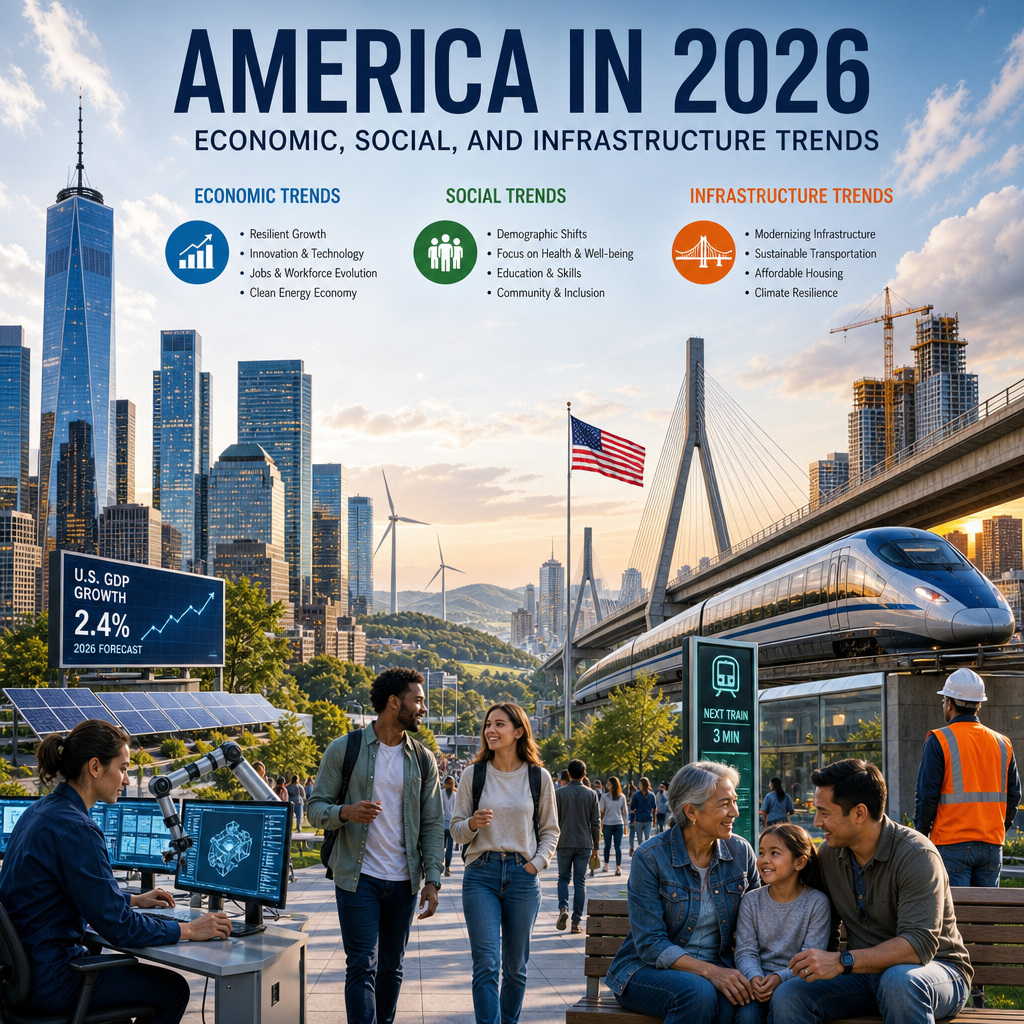
America in 2026 is being shaped by a mix of change and continuity. The economy is adjusting to new technologies, shifting labor expectations, higher public attention on affordability, and major investments in infrastructure. Social trends are evolving as communities respond to demographic changes, new work patterns, and growing concern about trust, health, and quality of life. At the same time, infrastructure—from roads and transit to broadband and the power grid—remains a central issue for everyday Americans and long-term national growth.
Understanding America in 2026 means looking beyond headlines. It requires seeing how economic signals connect to social behavior and how infrastructure decisions affect everything from housing costs to job access. Whether you’re a business owner, policymaker, investor, or simply a curious reader, these trends help explain where the country may be headed next.
America in 2026: The Big Picture
The most important thing to know about America in 2026 is that the country is balancing opportunity with pressure. New industries are expanding, but many households still feel squeezed by the cost of living. Digital tools are making work and services more efficient, but not everyone has equal access to them. Public and private investment is flowing into infrastructure, yet many systems still need repairs or modernization.
Several broad forces are shaping the year:
A labor market that continues to evolve after years of disruption
Persistent attention on inflation, wages, and affordability
Strong interest in AI, automation, and digital productivity
Ongoing changes in family structure, migration, and community life
Infrastructure upgrades tied to energy, transportation, and connectivity
These forces do not operate separately. They overlap in ways that influence daily life and long-term planning.
Economic Trends Shaping America in 2026
A labor market that values flexibility and skills
One of the defining economic trends in America in 2026 is the growing importance of skills over job titles. Employers are still looking for reliable workers, but they increasingly want candidates who can adapt, learn quickly, and use digital tools.
This is especially visible in:
Technology and data-focused roles
Healthcare and elder care
Construction and skilled trades
Logistics and supply chain operations
Customer service jobs that now rely on automation support
Remote and hybrid work remain part of the landscape, though not as dominant as they once were. Many companies have settled into flexible models that balance productivity, collaboration, and employee expectations. As a result, workers are paying more attention to commute times, home office needs, and career mobility.
Consumer behavior remains cautious
In 2026, many households continue to make spending decisions carefully. People are more price-sensitive than they were before recent periods of inflation and uncertainty. That affects everything from grocery shopping to travel, entertainment, and home improvement.
Common patterns include:
Comparing prices more often
Favoring value brands or subscription bundles
Delaying big purchases when possible
Looking for financing options with clearer terms
Prioritizing necessities over discretionary spending
At the same time, consumers are still willing to spend on experiences, health, convenience, and products that save time. Businesses that understand this balance are better positioned to succeed.
Small business resilience and pressure
Small businesses remain a vital part of the American economy, but they face a mixed environment in America in 2026. Many owners are adopting digital payment systems, online marketing, scheduling software, and AI-assisted tools to reduce overhead and improve service. Others are struggling with labor shortages, insurance costs, rent, and supply chain complexity.
The most resilient small businesses tend to do a few things well:
Keep operations lean without cutting service quality
Invest in local customer relationships
Use digital tools to reduce manual work
Adjust quickly to changing demand
Watch margins closely
This adaptability is becoming a competitive advantage.
Productivity, AI, and automation
Artificial intelligence is no longer a future topic. In America in 2026, AI is becoming part of everyday work in offices, warehouses, schools, hospitals, and retail environments. Many organizations are using it for tasks like drafting content, analyzing data, handling service requests, and identifying patterns.
The economic impact is not simple. AI can improve efficiency and create new opportunities, but it can also reshape jobs and increase competition. Workers who can use these tools effectively are likely to have an edge. Companies that deploy them thoughtfully may reduce costs and improve service, but they also need strong policies around privacy, accuracy, and accountability.
Social Trends Defining America in 2026
A stronger focus on mental health and well-being
Social conversations in America in 2026 increasingly center on well-being. More people are open about stress, burnout, loneliness, and the need for healthier routines. This shows up in workplaces, schools, and community programs.
What this means in practice:
Employers are expanding wellness benefits
Schools are paying more attention to student mental health
Families are discussing digital balance and screen time
Communities are investing in support networks and outreach
While awareness alone does not solve deep issues, it has changed the conversation. Mental health is now treated as a mainstream concern rather than a private or rare one.
Changing family and community patterns
American households are more diverse than ever. Some families include multiple generations under one roof. Others are delayed in having children, choosing not to marry, or relying on extended family and close friends instead of traditional structures.
These changes influence housing demand, caregiving needs, education planning, and local community life. They also affect how people shop, travel, and use public services.
In many places, communities are responding by offering:
More flexible childcare options
Senior support programs
Multi-use public spaces
Local events designed to reduce isolation
Volunteer and mutual aid networks
The social fabric is not disappearing, but it is being rewoven in new ways.
Trust, information, and media habits
Another major social trend in America in 2026 is the continued challenge of trust. People consume news from many sources, but they often worry about misinformation, bias, and overload. Social platforms, podcasts, newsletters, and independent creators compete with traditional outlets for attention.
As a result, many Americans have become more selective about what they believe and share. That has benefits and drawbacks. On one hand, people are more skeptical and more likely to verify claims. On the other hand, fragmentation can make it harder to build shared understanding across communities.
Health, aging, and long-term care
America’s population continues to age, and that affects both social systems and family life. Older adults need more healthcare services, transportation support, and accessible housing. Families often take on caregiving responsibilities that affect work and finances.
This trend influences:
Demand for home health care
Need for age-friendly housing
Pressure on medical staffing
Interest in telehealth and remote monitoring
Community planning around accessibility
These changes are not temporary. They are part of the social reality of America in 2026 and beyond.
Infrastructure Trends in America in 2026
Roads, bridges, and transit modernization
Infrastructure remains one of the most visible challenges in America in 2026. Many roads, bridges, and transit systems need upgrades to improve safety, reliability, and efficiency. Public spending and private partnerships are helping move projects forward, but progress varies widely by region.
The most important priorities include:
Repairing aging roads and bridges
Improving public transit in growing metro areas
Reducing congestion around freight corridors
Updating traffic management systems
Designing infrastructure that can handle extreme weather
For many Americans, infrastructure is not an abstract policy issue. It affects commute times, shipping delays, emergency response, and the cost of goods.
Broadband and digital access
Reliable internet access is now as important as many traditional utilities. In America in 2026, broadband expansion remains a major focus, especially in rural and underserved urban areas. Access to fast, affordable internet affects education, remote work, telehealth, business formation, and civic participation.
Key issues include:
Expanding fiber and wireless coverage
Lowering the cost of service
Increasing digital literacy
Supporting public access points in libraries and schools
Making sure infrastructure reaches areas with lower population density
Digital access is not only about speed. It is about whether people can fully participate in modern life.
Energy systems and grid reliability
The energy infrastructure conversation is changing quickly. America in 2026 is seeing continued investment in grid reliability, renewable generation, storage, and transmission. The challenge is to meet rising demand while keeping costs manageable and maintaining resilience.
This matters because energy affects:
Household utility bills
Business operating costs
Electric vehicle adoption
Manufacturing growth
Disaster preparedness
Upgrading the grid is a long-term project, but it is central to the country’s economic future.
Housing and water systems
Housing remains closely tied to infrastructure. In many regions, the shortage of affordable homes is made worse by zoning restrictions, limited construction, and outdated utilities. Water systems also need attention, including pipes, treatment facilities, and leak prevention.
In practical terms, this means communities must think about:
Where growth can happen
How to support denser housing
How to manage stormwater and flooding
How to maintain safe drinking water
How to coordinate land use with infrastructure planning
When infrastructure keeps pace with growth, communities become more livable and economically flexible.
How These Trends Affect Everyday Americans
For workers
Workers in America in 2026 are navigating a changing job market. Opportunities are strong in some sectors, but competition and retraining are ongoing realities. Those who invest in digital skills, communication, and adaptability are better positioned for growth.
For families
Families are balancing costs, caregiving, education, and health in a more complex environment. Affordable housing, reliable transit, and strong internet access all matter more than ever because they shape daily routines.
For businesses
Businesses that understand America in 2026 are focusing on efficiency, customer experience, and resilience. They are using technology more strategically, but they are also paying attention to local relationships and workforce retention.
For communities
Local leaders are being asked to solve multiple problems at once: improve infrastructure, support public safety, strengthen trust, and expand opportunity. The communities that succeed are often the ones that plan ahead and communicate clearly.
What to Watch Next
If you want to understand where America in 2026 is headed, keep an eye on these indicators:
Job growth in healthcare, construction, logistics, and tech-adjacent roles
Consumer confidence and household spending patterns
Adoption of AI in everyday business operations
Broadband expansion in rural and low-income areas
Progress on roads, bridges, grid reliability, and housing
Community responses to caregiving and mental health needs
These signals will not tell the whole story, but they will reveal whether the country is building a more stable and adaptable future.
Frequently Asked Questions
What does “America in 2026” mean in a practical sense?
It refers to the major economic, social, and infrastructure changes shaping life in the United States during 2026. That includes labor trends, consumer behavior, community change, technology adoption, and public investment in systems like transportation, energy, and broadband.
What is the biggest economic trend in America in 2026?
A major economic trend is the shift toward skills-based work and digital productivity. Employers increasingly value adaptability, technical fluency, and the ability to work with tools like automation and AI. At the same time, many households remain focused on affordability and value.
How is social life changing in America in 2026?
Social life is being shaped by growing attention to mental health, changing family structures, aging populations, and evolving media habits. People are also rethinking how they build community, trust information, and maintain balance in a highly connected world.
Why is infrastructure such a big issue in America in 2026?
Infrastructure affects daily life in direct ways. Roads, bridges, transit, broadband, water systems, and the power grid all influence safety, cost of living, business performance, and access to opportunity. Aging systems and new demand make infrastructure a high-priority issue.
What skills will matter most in America in 2026?
Skills that matter most include digital literacy, communication, problem-solving, adaptability, and the ability to use AI and automation responsibly. Hands-on trades, healthcare skills, and logistics expertise are also in strong demand.
America in 2026 is defined by adjustment, innovation, and the need for practical solutions. The economy is rewarding flexibility and digital fluency, but it also reflects caution as households and businesses manage costs. Social trends show a country that is more aware of mental health, aging, trust, and changing family life, while infrastructure remains a foundational issue that touches nearly every part of daily living.
The common thread across these trends is adaptability. Communities that invest in broadband, transportation, energy, and housing will be better prepared for growth. Workers who build new skills will be better positioned for opportunity. Families and businesses that stay informed and flexible will be more resilient in a fast-changing environment.
If you want to understand the direction of the country, follow the places where economics, society, and infrastructure intersect. That is where America in 2026 is being shaped most clearly—and where its future will be decided.
Peter B holds a degree in Journalism and has 5 years of experience covering U.S. economic policy, labor markets, and financial news. He writes data-driven news content on topics like inflation, interest rates, and employment trends.