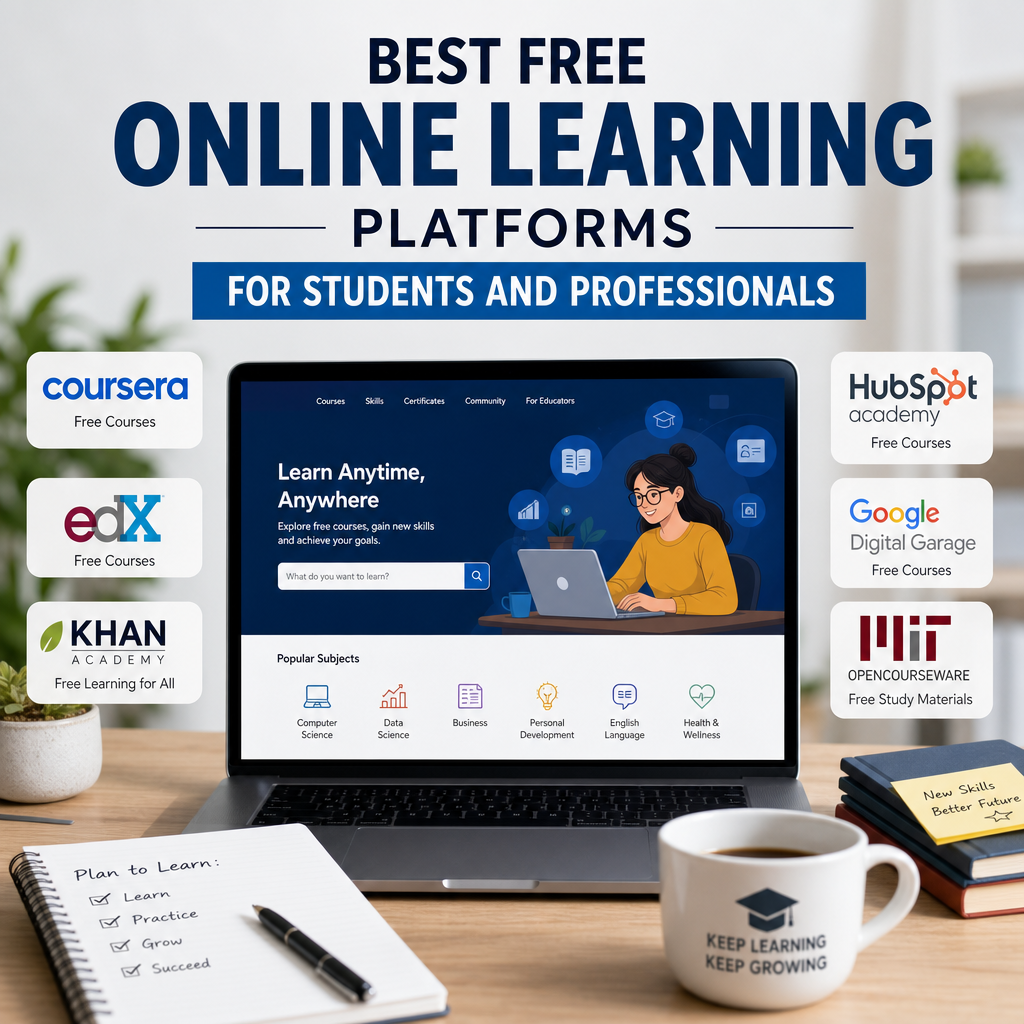
Best Free Online Learning Platforms for Students and Professionals
Looking for free online learning platforms that actually help you build real skills? This guide highlights the best options for students and professionals, making it easier to learn at your own pace without spending a dime.
By: Jennifer on July 24, 2026
Best Free Online Learning Platforms for Students and Professionals
Online education has changed how people build skills, earn credentials, and stay competitive in a fast-moving job market. Whether you are a student trying to strengthen your academic foundation or a working professional looking to reskill, the best free online learning platforms for students and professionals can open the door to flexible, high-quality learning without a big financial commitment.
From coding and business to design, data, writing, and personal productivity, today’s platforms make it possible to learn from trusted institutions and industry experts at your own pace. The challenge is not finding options—it’s choosing the right one for your goals, learning style, and schedule.
Why Free Online Learning Platforms Matter
Free online learning platforms give learners a low-risk way to explore new subjects, improve job-related skills, and prepare for certifications or future degrees. They are especially useful for people who need flexibility.
Benefits for students
Students often use free platforms to:
Review class material in a simpler format
Explore topics not covered in school
Prepare for exams and standardized tests
Strengthen college and career readiness
Build early digital and technical skills
Benefits for professionals
Professionals use them to:
Learn new tools and technologies
Improve leadership, communication, and project management skills
Pivot into a new career field
Stay current in a changing industry
Fill small skill gaps between jobs or promotions
The best part is that many free platforms offer enough quality content to help you learn meaningfully before you decide whether a paid certificate or premium feature is worth it.
Best Free Online Learning Platforms for Students and Professionals
Below are some of the strongest free online learning platforms available today. Each one serves a different purpose, so the best choice depends on what you want to learn.
1. Khan Academy
Khan Academy is one of the most trusted free learning platforms for school-age learners and anyone who wants to rebuild foundational knowledge. It covers math, science, grammar, economics, history, and test preparation.
Why it stands out:
Completely free core learning content
Strong for K–12 and early college-level topics
Clear explanations and practice exercises
Useful for self-paced review and homework support
Best for:
Students in middle school, high school, and early college
Learners who want structured lessons and practice
Parents helping children with schoolwork
2. Coursera
Coursera partners with universities and companies around the world to offer courses in technology, business, health, data science, and more. Many courses can be audited for free, which means you can access lectures and learning materials without paying.
Why it stands out:
Courses from respected universities and companies
Wide variety of professional and academic topics
Flexible self-paced learning
Great for exploring career fields before investing in a certificate
Best for:
College students building career skills
Professionals seeking job-relevant knowledge
Learners interested in university-style instruction
3. edX
edX is another major platform offering courses from top universities and institutions. Like Coursera, it provides free access to many course materials through audit options. It is especially strong in computer science, business, engineering, and data-related topics.
Why it stands out:
University-backed course quality
Strong academic and technical subject coverage
Good for learners who want rigorous material
Many courses support self-paced study
Best for:
Students preparing for college or advanced coursework
Professionals exploring technical or analytical skills
Learners who want a more structured academic experience
4. LinkedIn Learning
LinkedIn Learning is a popular platform for professional development, especially in business, software, creative, and productivity topics. It is usually subscription-based, but many libraries, schools, and employers provide free access to users with an account.
Why it stands out:
Career-focused, practical courses
Short lessons that fit busy schedules
Strong coverage of software, leadership, and workplace skills
LinkedIn profile integration can help showcase learning
Best for:
Professionals aiming to improve workplace performance
Job seekers building relevant skills quickly
Students preparing for internships or first jobs
5. Alison
Alison offers free online courses and certificates across a broad range of subjects, including IT, language learning, management, health, and personal development. It is one of the more accessible platforms for learners who want free coursework with optional paid certificates.
Why it stands out:
Large catalog of free courses
Useful for beginner-friendly career exploration
Certificate and diploma options available
Topics span both academic and professional interests
Best for:
Self-directed learners
Career changers on a budget
Professionals seeking introductory training in new areas
6. MIT OpenCourseWare
MIT OpenCourseWare gives public access to a large collection of MIT course materials. It does not always include live instruction or graded interaction, but it offers exceptional depth for learners who want high-level academic content.
Why it stands out:
Free access to real university course materials
Excellent for advanced math, science, engineering, and computer science
Strong resource for motivated independent learners
Great for supplementing classroom learning
Best for:
Students in STEM fields
Professionals who want deep subject knowledge
Self-starters comfortable with independent study
7. OpenLearn
OpenLearn, from The Open University, offers free courses across a broad range of subjects. The platform is well organized and beginner friendly, with a focus on accessible learning and personal development.
Why it stands out:
Free courses from a respected educational institution
Easy-to-navigate learning paths
Topics include business, languages, health, and study skills
Good mix of academic and practical content
Best for:
Students needing study support
Professionals exploring new interests
Learners who prefer guided introductions to topics
8. Udemy Free Courses
Udemy includes many free courses alongside its paid catalog. While course quality varies more than on university-backed platforms, it can still be useful for learning software tools, creative skills, and practical basics.
Why it stands out:
Broad topic coverage
Many short, skill-focused courses
Helpful for quick introductions to tools and platforms
Easy to search by topic and level
Best for:
Learners seeking quick skill refreshers
Beginners exploring a topic before committing money
Professionals wanting practical tutorials
How to Choose the Right Platform
The best free online learning platform is the one that matches your goal, learning style, and time commitment. A platform with excellent content may still be the wrong fit if the format feels too advanced or too casual for your needs.
1. Define your goal
Ask yourself what you want from the course:
Are you trying to improve grades?
Learn a new job skill?
Switch careers?
Prepare for a certification?
Explore a topic out of curiosity?
Your goal should narrow your options quickly.
2. Consider the course format
Some learners do best with:
Video lessons
Reading-based modules
Practice quizzes
Projects and assignments
Audio-friendly lessons for commuting
If you like structure, platforms like Khan Academy or OpenLearn may work well. If you want career-focused lessons, Coursera, edX, or LinkedIn Learning may fit better.
3. Look at the subject depth
A free course can be:
Introductory
Intermediate
Advanced
Students may need foundational support, while professionals often want practical, job-ready skills. Check whether the course explains concepts clearly or assumes prior knowledge.
4. Check for certificates or portfolio value
Not every learner needs a certificate, but it can help in certain cases. If you want to show evidence of learning, consider whether the platform offers:
Completion certificates
Shareable badges
Portfolio projects
Skills assessments
5. Make sure the platform is credible
Trust matters. Look for platforms backed by:
Universities
Recognized organizations
Established training companies
Public educational institutions
This helps ensure the content is accurate, up to date, and worth your time.
Tips to Learn Effectively on Free Platforms
Free access is valuable, but results depend on how you use the platform. A solid learning habit matters more than the platform alone.
Create a realistic schedule
You do not need to study for hours every day. Instead, choose a pace you can maintain:
20–30 minutes daily
One hour three times a week
Weekend study blocks
Consistency helps more than occasional marathon sessions.
Take notes and review them
Write down:
Key terms
Questions you still have
Useful examples
Action steps you can apply later
This makes it easier to remember what you learn and use it in real life.
Apply what you learn right away
Practice turns knowledge into skill. For example:
If you are learning Excel, build a sample spreadsheet
If you are learning coding, write small practice projects
If you are studying writing, draft a short blog post or memo
If you are learning business skills, apply them to a class project or work task
Combine platforms if needed
You do not have to rely on just one site. A student might use Khan Academy for foundational math and edX for a more advanced computer science topic. A professional might use LinkedIn Learning for workplace skills and Coursera for deeper learning.
Best Use Cases by Learner Type
Different learners benefit from different platforms. Here are a few practical examples.
For high school students
A student struggling with algebra may use Khan Academy for step-by-step instruction, then practice problems daily until the concepts feel easier. If the student wants to explore a future career in technology, a free intro course on Coursera or edX can provide a preview.
For college students
A college student preparing for internships may use LinkedIn Learning or Coursera to build skills in Excel, public speaking, project management, or digital marketing. These additions can complement classroom learning and strengthen a resume.
For working professionals
A project coordinator wanting to move into management might use OpenLearn or Alison for leadership fundamentals, then switch to a more specialized Coursera or LinkedIn Learning course on communication and team management.
For career changers
Someone moving from customer service to IT support could start with beginner courses on hardware, operating systems, and troubleshooting. Free learning platforms are a low-pressure way to test interest before enrolling in a formal program.
Common Mistakes to Avoid
Free learning platforms are powerful, but they can become overwhelming if you do not use them carefully.
Choosing too many courses at once
It is easy to collect a long list of courses and finish none of them. Start with one clear goal and one course at a time.
Ignoring course quality
Not every free course is excellent. Read descriptions carefully, look at instructor credentials when available, and choose platforms with strong reputations.
Skipping practice
Watching videos alone rarely leads to mastery. Use quizzes, exercises, and projects whenever possible.
Forgetting to track progress
Keep a simple list of courses completed, notes taken, and skills learned. This makes it easier to stay motivated and show progress over time.
Frequently Asked Questions
Are free online learning platforms actually worth using?
Yes, many free online learning platforms are worth using, especially when they come from trusted institutions or established education companies. They can help you build foundational knowledge, practice skills, and explore new subjects without financial pressure. The main difference between free and paid versions is often access to certificates, graded assignments, or instructor support.
Which free platform is best for students?
For many students, Khan Academy is one of the best free platforms because it offers clear instruction, practice exercises, and strong support for core subjects. Students who want university-level content may also benefit from Coursera, edX, or MIT OpenCourseWare, depending on the subject and difficulty level.
Which free platform is best for professionals?
Professionals often benefit from LinkedIn Learning, Coursera, and edX because these platforms focus on workplace skills, technology, business, and career development. If you need quick, practical training, LinkedIn Learning is especially useful. If you want deeper academic or technical learning, Coursera and edX are strong choices.
Can I get a certificate from free courses?
Sometimes, yes. Many platforms allow free access to course content but charge for certificates. Others offer free certificates or badges for certain courses. Always check the course details before enrolling if a certificate matters for your resume or professional profile.
How do I stay motivated when learning online for free?
Set one specific goal, choose a manageable schedule, and track your progress. It also helps to apply what you learn in real situations, such as school assignments, work tasks, or personal projects. Learning feels more rewarding when you can see practical results.
The best free online learning platforms for students and professionals make education more accessible, flexible, and practical than ever before. Whether you need help with school subjects, want to gain job-ready skills, or hope to explore a new career path, there is a platform that fits your goals. Khan Academy is excellent for building foundations, while Coursera and edX offer university-backed learning. MIT OpenCourseWare is ideal for advanced independent study, and LinkedIn Learning, Alison, OpenLearn, and Udemy Free Courses can support targeted skill development.
The key is to choose one platform that matches your goal and use it consistently. Free learning works best when you treat it like an investment of time and focus, not just a collection of videos or lessons. Start small, apply what you learn, and build momentum one topic at a time. With the right platform and a steady plan, you can strengthen your knowledge, improve your confidence, and create new opportunities for school, work, and beyond.
Jennifer, M.Ed., holds a degree in Higher Education Administration, with
a focus on U.S. college financial aid, admissions policy, and student
support systems. She researches and writes about scholarships, federal
aid programs, and the college planning process to help students and
families make informed, well-supported decisions.