Community College vs University: Which Is the Better Choice?
Choosing between community college vs university comes down to your goals, budget, and the kind of experience you want. Community college can offer a flexible, affordable start, while a university may provide more campus life, specialized programs, and a direct path to a bachelor’s degree.
By: Jennifer on July 24, 2026
Choosing between community college vs. university is one of the most important decisions students make after high school. The right path can shape your finances, your academic experience, and even how quickly you reach your career goals. But there is no universal answer. The better choice depends on your priorities, budget, learning style, and long-term plans.
For some students, community college offers a smart, affordable start. For others, a university provides the full campus experience, specialized programs, and a direct route into a four-year degree. Understanding the differences can help you make a confident decision instead of a rushed one.
Community College vs. University: The Main Differences
At a basic level, community colleges usually offer two-year associate degrees, certificates, and transfer pathways to four-year institutions. Universities generally offer bachelor’s degrees and beyond, including master’s and doctoral programs.
But the differences go far beyond degree length.
Cost and financial impact
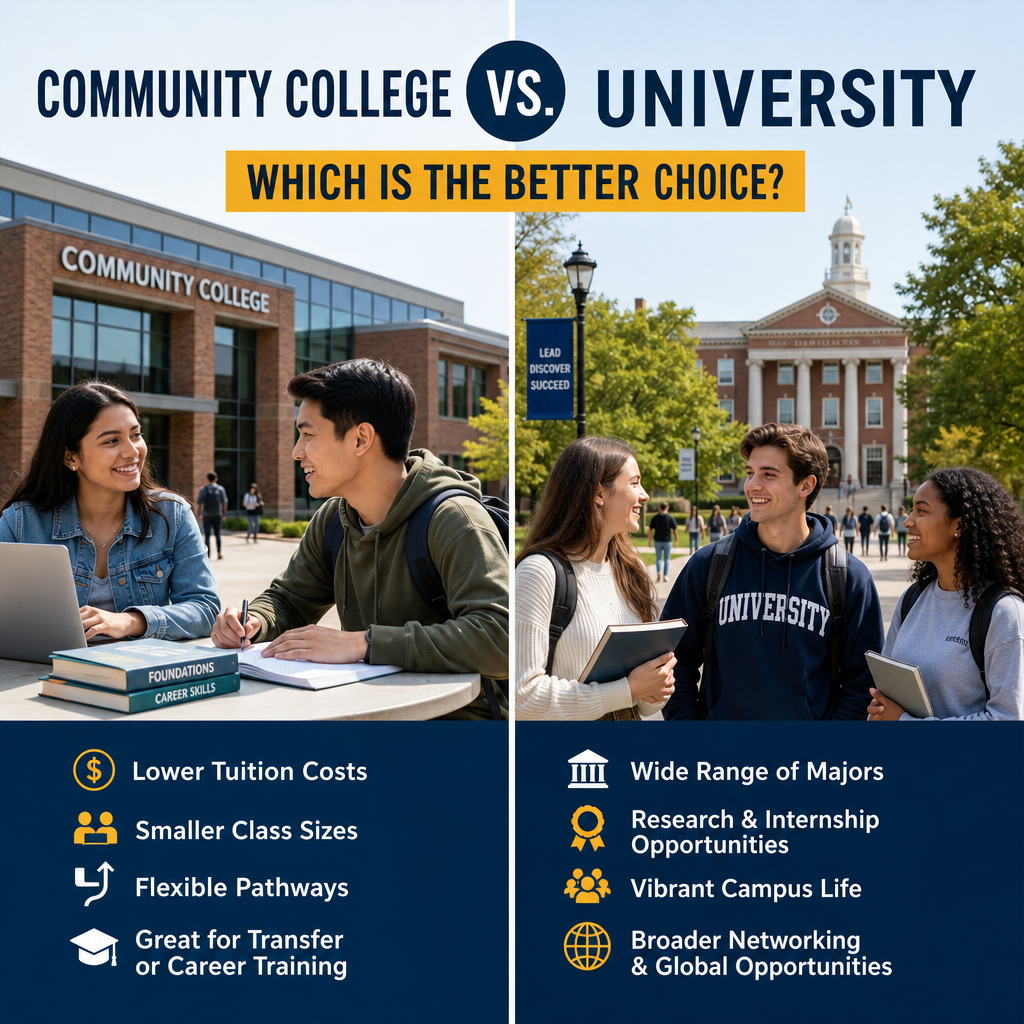
One of the biggest advantages of community college is lower tuition. For students who want to reduce debt, this can be a major benefit. Community colleges often cost far less per credit hour than universities, and many are designed to serve local residents at accessible prices.
Universities, especially public out-of-state or private institutions, usually come with higher tuition and broader fees. That said, many universities also offer scholarships, grants, and work-study opportunities that can help offset the cost.
When comparing community college vs. university, think about:
Tuition and fees
Room and board
Transportation
Books and supplies
Lost income if one option takes longer to complete
A lower-cost start at a community college can create flexibility later, especially if you plan to transfer.
Campus life and student experience
Universities often provide a more traditional residential experience. Students may live on campus, join clubs, attend sporting events, and participate in a wide range of activities. This can be a strong fit for students who want independence and a lively college environment.
Community colleges tend to be more commuter-oriented. Students often live at home, attend class, and head to work or family responsibilities afterward. This can make community college a practical choice for students who need schedule flexibility or want to stay close to home.
Neither environment is inherently better. The right fit depends on what kind of college experience you want.
Class size and learning environment
Community colleges often have smaller class sizes, which can mean more personal attention from instructors and easier access to support. This can help students who are adjusting to college-level expectations or prefer a more hands-on learning setting.
Universities may have large introductory lecture classes, especially during the first two years. Later, class sizes often get smaller as students move into major-specific courses. If you’re comfortable learning in a more independent setting, this may not be a drawback.
Degree options and academic pathways
Universities offer a wider range of bachelor’s degree programs and more specialized majors. If you already know you want to study engineering, architecture, nursing, or another field that requires a specific four-year path, a university may be the most direct route.
Community colleges are ideal for:
Earning an associate degree
Completing general education requirements
Testing academic interests before committing to a major
Preparing to transfer to a university
Gaining job-ready certificates in technical fields
Many students use community college as a stepping stone rather than a final destination. That can be a strategic move, not a compromise.
When Community College Makes the Most Sense
Community college can be the better choice in several situations. If any of the following apply, it may be worth serious consideration.
You want to save money
If budget matters, community college can reduce the overall cost of a degree. Students who complete the first two years at a community college and then transfer may spend significantly less than peers who attend a four-year university from the start.
This route can also reduce the need for student loans, which can make a big difference after graduation.
You are unsure about your major
Many students begin college without a clear career direction. Community college gives you time to explore subjects without the pressure of choosing an expensive four-year track immediately. You can complete general education courses, talk with advisors, and discover what interests you.
You need a flexible schedule
Community colleges often serve students who work part-time, care for family members, or balance other responsibilities. Classes may be available in the evenings, on weekends, or online. That flexibility can make education more realistic for adult learners and busy students.
You want a smoother transition into college
The move from high school to college can be challenging. Smaller classes and more accessible support services may help students build confidence before transferring to a university. For students who need to strengthen study habits or academic skills, this can be especially valuable.
When a University May Be the Better Choice
A university is not automatically more expensive in the long run, and for some students, it is the strongest fit from the beginning.
You want a specific bachelor’s degree path
Some majors are best pursued at a university because the coursework is structured from the start. Fields such as engineering, business, education, and health sciences may benefit from early specialization and access to advanced facilities or faculty research.
You value campus involvement
If you want to live on campus, join student organizations, attend events, or build a more immersive college experience, a university may align better with your goals. Many students find that campus life helps them build friendships, confidence, and a sense of belonging.
You plan to pursue graduate school
If your long-term plan includes a master’s degree, law school, or another advanced program, a university may offer a clearer path. You may also benefit from research opportunities, faculty mentorship, and academic advising tied to graduate preparation.
You want access to broader resources
Universities often provide:
Extensive libraries and labs
Career services
Internships and employer connections
Research opportunities
Alumni networks
These resources can be helpful when you’re preparing for a competitive career or looking to build a professional network early.
Community College vs. University: How to Compare Your Options
The best decision comes from looking beyond labels. Instead of asking which school sounds more prestigious, ask which one supports your goals.
1. Compare total cost, not just tuition
A school with lower tuition is not always cheaper overall. Add up the full cost of attendance, including housing, transportation, and daily living expenses.
2. Think about your career path
Some careers require a bachelor’s degree or higher. Others can begin with a certificate or associate degree. Make sure the school you choose aligns with the credentials your field expects.
3. Review transfer policies
If you’re considering community college first, ask how credits transfer to four-year institutions. A well-planned transfer pathway can save time and money. Look for articulation agreements or transfer partnerships between schools.
4. Assess support services
Strong academic advising, tutoring, career counseling, and mental health resources can make a real difference. Don’t overlook student support when comparing schools.
5. Consider your learning style
Do you learn best in smaller classes with direct interaction? Or do you thrive in larger, more independent environments? The answer may help guide your choice.
Practical Scenarios: Which Path Fits Best?
Sometimes the easiest way to decide is to imagine a real-life situation.
Scenario 1: The budget-conscious student
Maria wants to become a nurse but cannot afford four years of high tuition right away. She starts at a community college, completes her prerequisites, and then transfers to a university nursing program. This path helps her manage costs while still reaching her career goal.
Scenario 2: The undecided student
Jordan has several interests but no clear major. He enrolls in community college, takes general education classes, and works with an advisor. By the end of the first year, he decides on accounting and transfers with a stronger sense of direction.
Scenario 3: The student who wants the full campus experience
Alyssa knows she wants to study biology and live on campus. She values extracurricular activities, research opportunities, and student life. For her, a university is the better fit because it matches both her academic and personal goals.
These examples show that the best choice depends on circumstances, not prestige alone.
Common Myths About Community College and University
There are plenty of misconceptions about both options. Let’s clear up a few of the most common ones.
Myth 1: Community college is only for students who couldn’t get into a university
Not true. Many students choose community college intentionally because it is affordable, flexible, and practical. It can be a strategic first step, not a fallback.
Myth 2: University is always the better investment
Also false. A university can be a great investment, but only if it fits your goals and budget. If you take on too much debt or choose a school that does not suit your needs, the return may not be worth it.
Myth 3: Community college limits your future
A strong transfer plan can open the same doors as starting at a university, especially if you complete your coursework carefully and maintain good grades. Many successful professionals began at community colleges.
Myth 4: University guarantees a better job
A degree can help, but outcomes depend on your field, experience, networking, internships, and skills. Employers often care about what you can do, not just where you studied.
Questions to Ask Before You Decide
If you’re still unsure about community college vs. university, ask yourself these questions:
What can I realistically afford?
What career do I want, and what degree does it require?
Do I want to live on campus or commute?
Do I prefer smaller classes or a larger university environment?
Am I ready for a four-year commitment, or do I want a more flexible start?
Will I likely transfer later?
Which school offers the best support for my goals?
Writing down your answers can make the decision clearer.
Frequently Asked Questions
1. Is community college a good first step before university?
Yes. For many students, community college is a smart first step because it lowers costs and allows them to complete general education courses before transferring to a university. It is especially useful for students who are undecided about a major or want a more flexible schedule.
2. Will my community college credits transfer to a university?
Often they will, but not always. Transferability depends on the courses you take, the institutions involved, and any existing transfer agreements. Before enrolling, ask both schools about articulation agreements and make sure the credits you earn will apply toward your intended bachelor’s degree.
3. Is a university degree better than a community college degree for jobs?
It depends on the career. Some jobs require a bachelor’s degree or higher, while others value an associate degree or certificate. In many cases, employers care about skills, experience, and relevant training. The best degree is the one that fits your career path.
4. Can I save money by starting at community college and transferring later?
Yes, this is one of the most common reasons students choose community college. By completing lower-cost general education courses first, you may reduce total tuition expenses. Just make sure your courses transfer cleanly so you do not lose time or credits.
5. How do I decide between community college vs. university if I’m still unsure?
Start with your goals, budget, and learning preferences. If you want affordability, flexibility, and time to explore, community college may be the better choice. If you want a residential experience, specialized programs, and broader campus resources, a university may be the right fit.
Deciding between community college vs. university comes down to more than tradition or reputation. The better choice is the one that matches your academic goals, financial reality, and preferred learning environment. Community college can offer an affordable, flexible start with smaller classes and a clear transfer pathway. University may provide a fuller campus experience, more specialized programs, and broader long-term resources.
If you are still weighing your options, focus on the practical details: total cost, degree requirements, support services, and transfer opportunities. Talk to advisors, research programs carefully, and think honestly about how you learn best. A thoughtful decision now can save money, reduce stress, and set you up for success later.
Whether you begin at a community college, enroll directly at a university, or move from one to the other, the most important step is choosing a path that supports your future. Education is not one-size-fits-all, and the right choice is the one that helps you move forward with confidence.
Jennifer, M.Ed., holds a degree in Higher Education Administration, with
a focus on U.S. college financial aid, admissions policy, and student
support systems. She researches and writes about scholarships, federal
aid programs, and the college planning process to help students and
families make informed, well-supported decisions.