Medicare Parts A, B, C, and D Explained for Beginners
Medicare Parts A, B, C, and D can seem confusing at first, but each piece plays a specific role in your health coverage. This beginner-friendly guide breaks down what each part covers and how to choose the right mix for your needs and budget.
By: Emilly Adams on July 25, 2026
Medicare Parts A, B, C, and D Explained: A Complete Beginner’s Guide
Understanding Medicare can feel overwhelming at first, especially when you’re trying to figure out the difference between Medicare Parts A, B, C, and D. The program is a major source of health coverage for people age 65 and older, as well as some younger people with disabilities, but the rules, enrollment periods, and plan choices can be confusing.
The good news is that the structure is simpler than it seems once you break it down. In this guide, we’ll explain what each part covers, how the pieces fit together, and how to choose coverage that matches your health needs and budget. Whether you’re approaching Medicare eligibility for yourself or helping a family member, this beginner-friendly overview will give you a clear starting point.
What Is Medicare?
Medicare is a federal health insurance program in the United States. It helps cover a wide range of medical services, but it does not pay for everything. That’s why it’s important to understand what each part includes and what extra coverage may be needed.
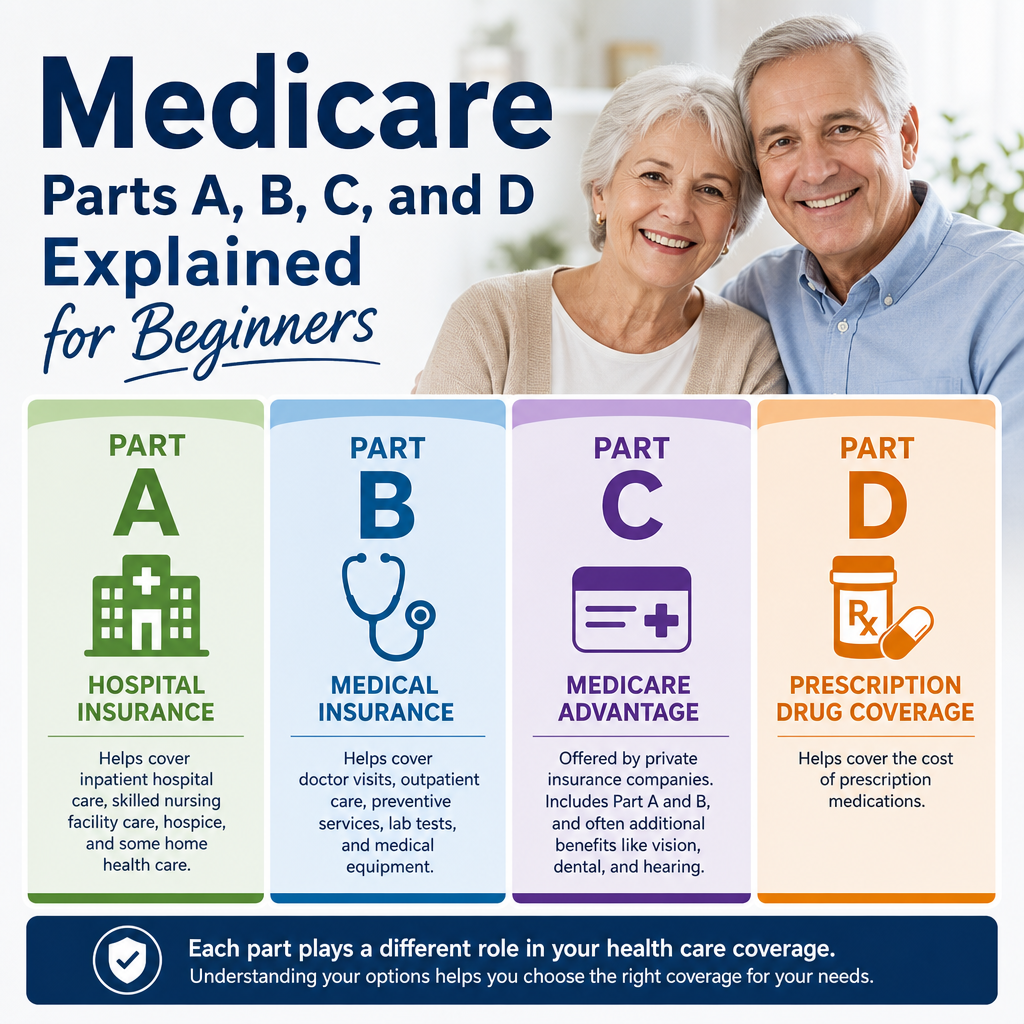
At its core, Medicare has four main parts:
Part A: Hospital insurance
Part B: Medical insurance
Part C: Medicare Advantage
Part D: Prescription drug coverage
Some people get their coverage through Original Medicare, which includes Parts A and B. Others choose a Medicare Advantage plan, which is Part C and is offered by private insurers approved by Medicare.
Medicare Part A: Hospital Insurance
Medicare Part A helps cover inpatient care and facility-based services. Most people first encounter Part A because it is often premium-free if they or a spouse paid Medicare taxes long enough while working.
What Part A covers
Part A generally helps pay for:
Inpatient hospital stays
Skilled nursing facility care after a qualifying hospital stay
Hospice care
Some home health care services
What Part A does not cover
Part A does not pay for everything related to hospital care. For example, it usually does not cover:
Long-term custodial care
Private-duty nursing
Most dental care
Routine vision care
Hearing aids
Why Part A matters
If you are admitted to a hospital, Part A is the foundation of your coverage. It can help protect you from major hospital bills, but you may still owe deductibles, coinsurance, and other out-of-pocket costs.
Medicare Part B: Medical Insurance
Medicare Part B covers medically necessary services and preventive care. While Part A is mainly for hospital-related care, Part B applies more to day-to-day medical needs.
What Part B covers
Part B typically helps pay for:
Doctor visits
Outpatient care
Preventive services like screenings and vaccines
Lab tests
Durable medical equipment, such as walkers or wheelchairs
Mental health services
Some home health care
Part B costs
Unlike many premium-free Part A situations, Part B usually requires a monthly premium. You may also be responsible for:
An annual deductible
Coinsurance
Copayments, depending on the service
Why Part B matters
Part B is essential because it covers the kinds of services most people use regularly. If you skip Part B when you first become eligible, you may face late enrollment penalties unless you qualify for a special enrollment period.
Medicare Part C: Medicare Advantage
Medicare Part C, also called Medicare Advantage, is an alternative way to receive your Medicare benefits. These plans are offered by private insurance companies approved by Medicare.
How Part C works
A Medicare Advantage plan replaces the way you receive Part A and Part B benefits. You still have Medicare, but your coverage is delivered through a private plan rather than through Original Medicare alone.
Most Medicare Advantage plans include:
Part A benefits
Part B benefits
Often Part D prescription drug coverage
Many also offer extra benefits such as:
Dental care
Vision care
Hearing services
Fitness programs
Transportation assistance
Important things to know about Part C
Medicare Advantage plans often use provider networks, which means you may need to see doctors and hospitals in the plan’s network. Some plans require referrals to see specialists, while others do not.
Also, your costs and rules may differ from Original Medicare. That means it’s important to review:
Monthly premiums
Copays
Deductibles
Network restrictions
Drug coverage details
Who should consider Part C?
Part C may be a good fit if you want:
One plan that bundles several benefits
Extra services not covered by Original Medicare
Predictable cost-sharing
Prescription coverage built into the plan
However, it may not be ideal if you prefer broader provider choice or travel frequently and need flexible access to doctors.
Medicare Part D: Prescription Drug Coverage
Medicare Part D helps pay for prescription drugs. Because Original Medicare generally does not cover most outpatient prescriptions, Part D is especially important for people who take regular medications.
What Part D covers
Each Part D plan has its own formulary, which is the list of covered drugs. Plans usually place medications into tiers that affect how much you pay.
Part D may cover:
Brand-name drugs
Generic drugs
Many common maintenance medications
Some vaccines and medical supplies
How Part D costs work
You may pay:
A monthly premium
A deductible, depending on the plan
Copays or coinsurance for prescriptions
Your total costs depend on the plan, the medications you take, and whether you use preferred pharmacies.
Why Part D matters
Prescription drug expenses can add up quickly, especially for people managing chronic conditions. Choosing the right Part D plan can make a real difference in annual health care costs.
How Medicare Parts A, B, C, and D Work Together
The biggest source of confusion is often how the parts relate to one another. Here’s the simplest way to think about it.
Original Medicare: Parts A and B
Original Medicare includes:
Part A for hospital coverage
Part B for medical coverage
With Original Medicare, you can usually see any doctor or hospital in the U.S. that accepts Medicare. However, it does not include most prescription drug coverage, and it doesn’t usually cover dental, vision, or hearing.
Adding Part D
If you stay with Original Medicare, you can often add a standalone Part D plan for drug coverage. This gives you:
Hospital coverage through Part A
Medical coverage through Part B
Prescription coverage through Part D
Choosing Part C instead
If you enroll in Medicare Advantage, your private plan usually combines Part A and Part B benefits and often includes Part D too. In that case, you generally do not use Original Medicare the same way.
In other words:
Original Medicare = Parts A and B
Original Medicare + Part D = hospital, medical, and drug coverage
Part C = an alternative way to get A and B, often with D included
Medicare Enrollment Basics
Knowing the parts is only half the story. You also need to understand when you can enroll.
Initial Enrollment Period
Most people first become eligible for Medicare around age 65. Your initial enrollment period is a seven-month window that includes:
The three months before your 65th birthday month
Your birthday month
The three months after your birthday month
Enrolling on time helps you avoid gaps in coverage and potential penalties.
General Enrollment Period
If you miss your initial sign-up opportunity, you may be able to enroll during the general enrollment period. However, late penalties can apply, especially for Part B and Part D.
Medicare Advantage Enrollment
You can join a Medicare Advantage plan during certain enrollment periods, including your initial enrollment period and the Medicare Open Enrollment Period.
Open Enrollment Period
Each year, Medicare’s Open Enrollment Period allows people to:
Switch from Original Medicare to Medicare Advantage
Switch from Medicare Advantage back to Original Medicare
Change Medicare Advantage plans
Join, switch, or drop a Part D plan
This is an important time to review whether your current plan still fits your needs.
How to Choose Between Original Medicare and Medicare Advantage
There is no one-size-fits-all answer. The right choice depends on your doctors, prescriptions, travel habits, and budget.
Original Medicare may be better if you want:
Broad provider access
Freedom to see specialists without many network limits
The option to add a Medigap policy for help with out-of-pocket costs
Medicare Advantage may be better if you want:
Bundled coverage in one plan
Extra benefits like dental or vision
A lower monthly premium in some cases
More predictable copays
Questions to ask before choosing
Consider these practical questions:
Are your current doctors in the plan’s network?
Are your prescriptions covered?
What will you pay for primary care and specialist visits?
Do you travel often or live in more than one state?
Do you need dental, vision, or hearing benefits?
Would you rather pay more each month for broader access, or less each month with more restrictions?
Common Mistakes Beginners Make
Many first-time Medicare enrollees make avoidable mistakes. Here are a few to watch for.
1. Assuming Medicare covers everything
Medicare is valuable, but it does not cover all medical costs. Understanding deductibles, copayments, and excluded services can help prevent surprises.
2. Missing enrollment deadlines
Late enrollment can create penalties and coverage delays. Mark your dates early and review them carefully.
3. Forgetting about prescription drugs
If you need medications, make sure your coverage includes them. Otherwise, you could pay much more than expected.
4. Not checking provider networks
This matters most with Medicare Advantage. A plan may look affordable but still be a poor fit if your doctors are out of network.
5. Ignoring total annual costs
A low monthly premium does not always mean a lower overall cost. Compare premiums, deductibles, copays, and drug costs together.
Practical Example: How the Parts Might Fit Together
Imagine you enroll in Original Medicare:
Part A covers your inpatient hospital stay after surgery
Part B covers the surgeon’s outpatient visits and follow-up appointments
You add a Part D plan to help pay for your prescription pain medication
Now imagine you choose Medicare Advantage instead:
Your plan includes hospital and medical benefits
Your prescriptions are covered through the same plan
You may also receive extra dental or vision benefits
Both approaches can work well. The best choice depends on how you use care and what kind of flexibility you want.
Tips for Comparing Medicare Options
When reviewing plans, focus on the details that affect your daily life and budget.
Make a simple checklist
List your doctors and specialists
Write down all current medications
Compare premiums and out-of-pocket costs
Check whether your preferred pharmacies are covered
Review plan rules for referrals and network use
Look at extra benefits only after the basics are covered
Use trusted tools
Medicare plan information can change each year. Use official sources and compare plans carefully before enrolling or switching.
Frequently Asked Questions
1. What are Medicare Parts A, B, C, and D?
Medicare Part A covers hospital-related services, Part B covers medical and outpatient care, Part C is Medicare Advantage, and Part D covers prescription drugs. Together, they form the main ways people receive Medicare benefits.
2. Do I need both Part A and Part B?
Most people enroll in both Parts A and B because they work together to provide full Original Medicare coverage. Part A covers hospital services, while Part B covers doctor visits, outpatient care, and preventive services.
3. Is Medicare Advantage the same as Original Medicare?
No. Medicare Advantage, or Part C, is an alternative way to receive Medicare benefits through a private insurance plan. Original Medicare refers to Parts A and B. Medicare Advantage often includes additional benefits and may include drug coverage.
4. Does Medicare Part D cover all prescription drugs?
No. Each Part D plan has a formulary, which is a list of covered medications. Plans vary, so it’s important to check whether your prescriptions are included and what your expected costs will be.
5. Can I have Medigap with Medicare Advantage?
Generally, no. Medigap policies are designed to work with Original Medicare, not Medicare Advantage. If you choose Medicare Advantage, you usually cannot use Medigap to supplement that same coverage.
Medicare may seem complicated at first, but the system becomes much easier to manage once you understand the purpose of each part. Part A helps with hospital care, Part B covers medical services and preventive care, Part C offers an all-in-one Medicare Advantage alternative, and Part D helps with prescription drug costs. Together, these parts give you flexible ways to build coverage that fits your health needs, provider preferences, and budget.
The key is to compare your options carefully instead of assuming the cheapest plan is the best one. Look at your doctors, medications, monthly premiums, out-of-pocket costs, and enrollment deadlines before making a decision. A little planning now can help you avoid penalties, reduce surprises, and choose coverage with confidence.
If you’re new to Medicare, keep learning, use official resources, and review your options every year. The more informed you are, the easier it becomes to make a smart choice for your health and finances.
Emily A, holds a Master's degree in Public Administration (MPA) and has over 7 years of experience researching federal and state assistance programs. She writes educational content focused on government benefits, public policy, and community resources, using information from official agencies to help readers understand available programs and eligibility requirements.