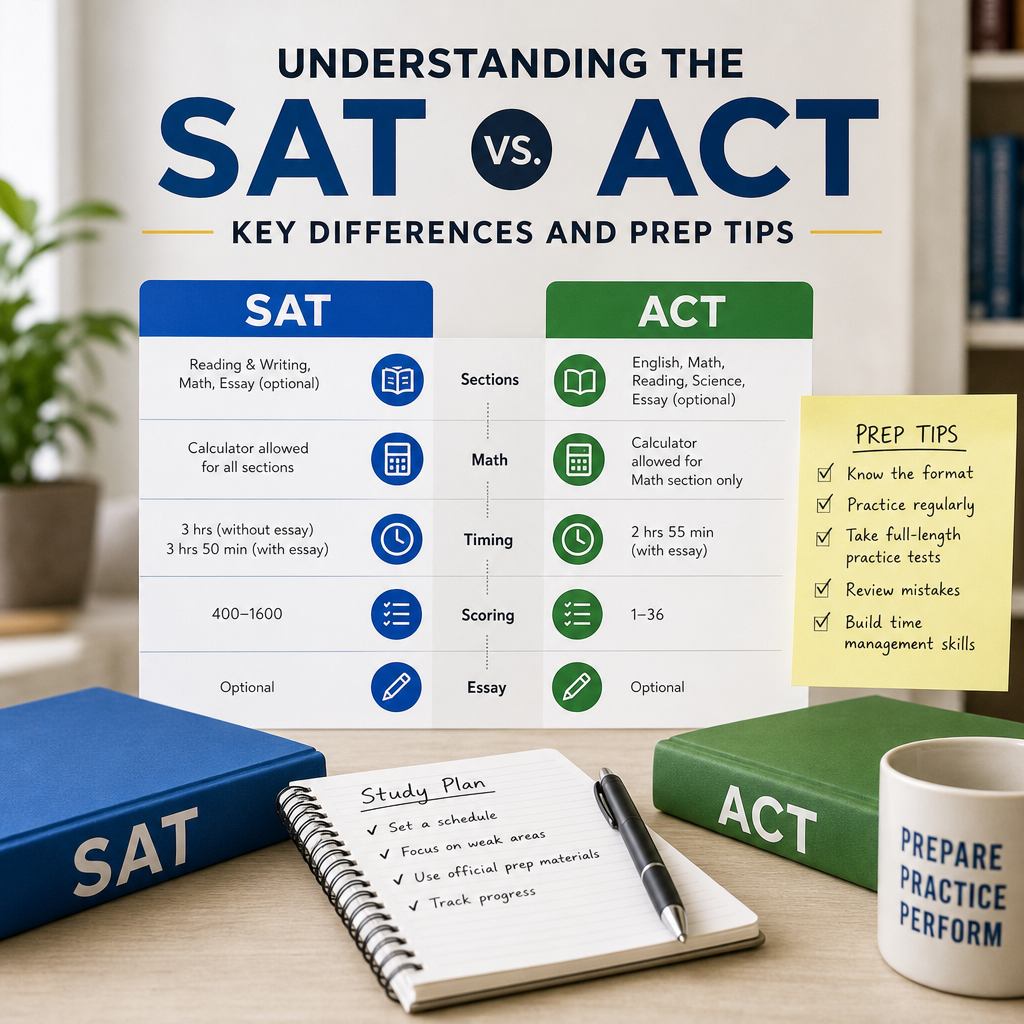
Understanding the SAT and ACT: Key Differences and Prep Tips
Understanding the SAT and ACT can make college test prep feel much less overwhelming. While both exams are widely accepted, knowing how they differ in format, pace, and content can help you choose the right test and prepare more effectively.
By: Jennifer on July 24, 2026
Understanding the SAT and ACT: Key Differences and Preparation Tips
If you’re comparing college admissions tests, understanding the SAT and ACT can make the decision feel much more manageable. Both exams are widely accepted by colleges in the United States, but they differ in format, pacing, and the skills they emphasize. Choosing the right test—and preparing for it strategically—can help students feel more confident and perform at their best.
This guide breaks down the key differences between the SAT and ACT, explains how to choose between them, and offers practical preparation tips that actually help. Whether you’re starting early or narrowing down your test plan now, a clear understanding of the SAT and ACT can save time and reduce stress.
SAT and ACT: What They Are and Why They Matter
The SAT and ACT are standardized tests used by many colleges and universities as part of the admissions process. While many schools now take a more holistic approach, strong test scores can still strengthen an application, support scholarship opportunities, or help demonstrate academic readiness.
Both exams are designed to measure college readiness, but they do so in different ways:
The SAT leans more heavily toward reasoning, evidence-based reading, and math problem-solving.
The ACT tends to be more direct, broader in content coverage, and faster paced.
Neither test is automatically “better.” The right choice depends on a student’s strengths, timing, and comfort with test format.
Key Differences Between the SAT and ACT
Understanding the main differences between the SAT and ACT is the first step toward choosing the right test.
Test Structure and Sections
The SAT and ACT each cover reading, writing/language, and math, but the structure is not identical.
SAT sections typically include:
Reading
Writing and Language
Math
An optional Essay section was once offered, but it is no longer part of the standard SAT administration.
ACT sections typically include:
English
Math
Reading
Science
Optional Writing section
One major difference is the ACT’s Science section. It does not require advanced science knowledge so much as data interpretation, analysis, and reasoning based on charts, graphs, and experiments. Students comfortable reading visuals quickly may find this section manageable.
Timing and Pacing
Pacing is one of the biggest distinctions between the SAT and ACT.
The SAT generally gives students more time per question.
The ACT moves more quickly and often feels more time-pressured.
This difference matters a lot. A student who likes to think carefully may prefer the SAT’s pace, while someone who works well under tighter time limits may do better on the ACT.
Question Style
The SAT and ACT ask students to think in different ways.
SAT questions often:
Include more evidence-based reading
Focus on problem-solving and analysis
Use fewer answer choices in some sections
Feel more like puzzles that reward careful thinking
ACT questions often:
Are more straightforward
Require quick recognition of grammar, math procedures, and reading details
Cover content more broadly
Reward speed and familiarity
For example, an SAT math question may ask a student to interpret a scenario and determine the best approach, while an ACT math question may present a more direct calculation.
Math Content
Both tests cover important high school math topics, but the emphasis differs.
SAT math includes:
Algebra
Problem solving and data analysis
Some advanced math
A smaller amount of geometry and trigonometry
ACT math includes:
Pre-algebra
Elementary and intermediate algebra
Coordinate and plane geometry
Trigonometry
More varied content overall
Students who are strong in advanced algebra and quantitative reasoning may lean toward the SAT, while students with broad math fluency and quick recall may prefer the ACT.
Reading and Writing/English Differences
The reading and language sections also differ in style.
SAT Reading and Writing:
Combines reading comprehension with grammar and rhetoric skills
Often asks students to support answers with evidence
Emphasizes analysis of passages and relationships between ideas
ACT English and Reading:
English focuses heavily on grammar, usage, punctuation, and sentence structure
Reading asks students to locate information efficiently
Questions are often more direct and less inference-heavy than the SAT
If a student is especially strong in grammar and can move quickly through passages, the ACT may feel more natural. If they prefer deeper reasoning and textual analysis, the SAT may be the better fit.
How to Choose Between the SAT and ACT
Deciding between the SAT and ACT is often easier when students think about their own learning style and strengths.
Ask These Questions
A student may want to consider:
Do I work better with more time, or do I handle fast pacing well?
Am I stronger at analysis or quick recall?
Do I enjoy data and science-style reasoning?
Am I more comfortable with algebra-heavy math or a broader math range?
Which test format feels more natural after taking a practice exam?
A real-world example helps. Imagine two students:
Student A is careful, detail-oriented, and strong in algebra. They tend to slow down to avoid mistakes. The SAT may fit them well.
Student B reads quickly, knows grammar rules well, and works comfortably under time pressure. The ACT may suit them better.
Take a Practice Test for Each
One of the best ways to compare the SAT and ACT is to take a full-length practice test of both. This gives students a much better sense of:
Timing pressure
Question style
Endurance
Section strengths and weaknesses
Scores matter, but so does comfort. Sometimes a student performs similarly on both tests, yet one feels much less draining. That feeling can be important during an actual exam.
Smart Preparation Tips for the SAT and ACT
Once a student chooses a test, the next step is preparing with purpose. Good test prep is not just about cramming—it’s about building familiarity, accuracy, and confidence.
1. Start with a Diagnostic Test
Before studying, take a baseline practice test. This helps identify:
Strongest sections
Weakest sections
Timing issues
Common mistake patterns
A diagnostic test prevents wasted effort. Instead of studying everything equally, students can focus where improvement is most needed.
2. Build a Study Plan
A useful study plan should be realistic and specific. For example:
Week 1: Take a practice test and review mistakes
Week 2: Focus on grammar and punctuation rules
Week 3: Practice algebra and data questions
Week 4: Work on reading strategies and timing
Week 5: Take another timed practice test
Even 30 to 45 minutes a few times a week can make a difference when the studying is consistent.
3. Learn the Test Format
Students often improve faster when they understand the structure of the exam. Learn:
How many questions are in each section
How much time is available
Which question types appear most often
Whether guessing penalties apply
This kind of familiarity reduces surprises on test day.
4. Review Mistakes Carefully
Reviewing wrong answers is one of the most valuable parts of preparation for the SAT and ACT. Don’t just look at the correct answer—figure out why the wrong choice seemed tempting.
Useful questions include:
Did I misunderstand the question?
Did I rush?
Did I forget a math rule?
Did I miss key evidence in the passage?
Did I choose an answer too quickly?
Keeping a simple mistake log can help students spot recurring patterns.
5. Practice Under Timed Conditions
Because pacing differs so much between the SAT and ACT, timed practice is essential. Untimed work helps students learn concepts, but timed work builds test-day readiness.
Try these strategies:
Set a timer for each section
Practice moving on when stuck
Build stamina with full-length tests
Simulate real testing conditions as closely as possible
Students should get used to making quick decisions without panicking.
6. Strengthen Core Skills
Test prep works best when it includes skill-building, not just test tricks.
Focus on:
Reading comprehension
Grammar and punctuation
Algebra and geometry fundamentals
Data interpretation
Word problems
Mental math and estimation
A student who strengthens core skills is less dependent on memorizing shortcuts.
7. Use Official Practice Materials
Official practice resources are especially helpful because they reflect the real style and difficulty of the exam. Students should prioritize materials from the official test makers whenever possible.
These resources help students:
See authentic question wording
Practice with realistic timing
Avoid unreliable third-party assumptions
Track progress accurately
8. Keep a Balanced Schedule
Preparation should fit around school, activities, and rest. Overloading the schedule can lead to burnout. A balanced approach usually works better than marathon study sessions.
Helpful habits include:
Studying in short, focused blocks
Taking breaks
Sleeping well before practice and test days
Eating a good meal before testing
Staying organized with test dates and registration deadlines
Common Mistakes Students Make
Even motivated students sometimes make avoidable mistakes while preparing for the SAT and ACT.
Ignoring Timing
A student may know the material but still run out of time. If pacing is a problem, timed practice must become part of the study plan.
Focusing Only on Weak Areas
It’s tempting to spend all the time on the hardest section. But students also need to protect their strengths. Balanced prep helps maintain confidence and score stability.
Switching Tests Too Late
Some students jump between the SAT and ACT without enough testing data. It’s usually better to choose based on practice results and then commit long enough to prepare properly.
Skipping Review
Taking practice tests without reviewing mistakes limits progress. The real learning happens during review.
Test-Day Tips for Success
The day of the exam matters just as much as preparation. A calm, organized approach can improve performance.
Before the Test
Gather required documents the night before
Check the test location and arrival time
Get a full night of sleep
Eat a familiar breakfast
Bring approved supplies, such as a calculator and pencils
During the Test
Read instructions carefully
Pace yourself by section
Skip and return to difficult questions if needed
Use elimination to improve odds on multiple-choice questions
Stay focused on the current question instead of worrying about the last one
After the Test
Once the exam is over, resist the urge to overanalyze every answer. Instead, reflect on what worked and what could improve for future testing opportunities.
Frequently Asked Questions
1. Which is easier, the SAT or ACT?
There is no universal answer. The easier test depends on the student’s strengths. The SAT may feel easier for students who prefer more time and analytical reasoning, while the ACT may feel easier for students who think quickly and like straightforward questions. Taking practice tests is the best way to compare.
2. Do colleges prefer the SAT or ACT?
Most colleges accept both tests equally and do not prefer one over the other. Students should choose the exam that best reflects their abilities. Always check the admissions requirements for specific schools, especially if applying to specialized programs.
3. Should I take both the SAT and ACT?
Some students do take both, especially early in the process, to see which one produces a better result. However, preparing for two tests at once can be overwhelming. If the scores are similar, focusing on one test is usually more efficient.
4. How far in advance should I start preparing?
A few months of steady preparation is a good starting point for many students. Starting earlier allows time to build skills gradually, take practice tests, and avoid cramming. Students who need more improvement may benefit from an even longer timeline.
5. What is the best way to improve my score quickly?
The fastest improvements usually come from targeted practice. Review mistakes, focus on timing, and study the most frequently missed question types. For many students, grammar rules, algebra fundamentals, and reading strategy offer strong score gains when practiced consistently.
Understanding the SAT and ACT is about more than comparing two tests—it’s about matching the exam to the student. While both are respected college admissions tests, they differ in pacing, structure, content emphasis, and question style. That means the “best” choice is often the one that aligns with a student’s natural strengths and preparation habits.
The most effective approach is simple: take practice tests, study the results honestly, and build a focused plan based on real needs. Students who learn the format, practice under timed conditions, and review mistakes carefully usually make more progress than those who rely on general review alone.
Whether you’re aiming to boost a college application, qualify for scholarships, or simply feel more prepared, a thoughtful SAT or ACT strategy can make the process more manageable. Start with what you know, strengthen the areas that matter most, and keep your prep consistent. With the right plan, the test becomes less intimidating—and much more achievable.
Jennifer, M.Ed., holds a degree in Higher Education Administration, with
a focus on U.S. college financial aid, admissions policy, and student
support systems. She researches and writes about scholarships, federal
aid programs, and the college planning process to help students and
families make informed, well-supported decisions.