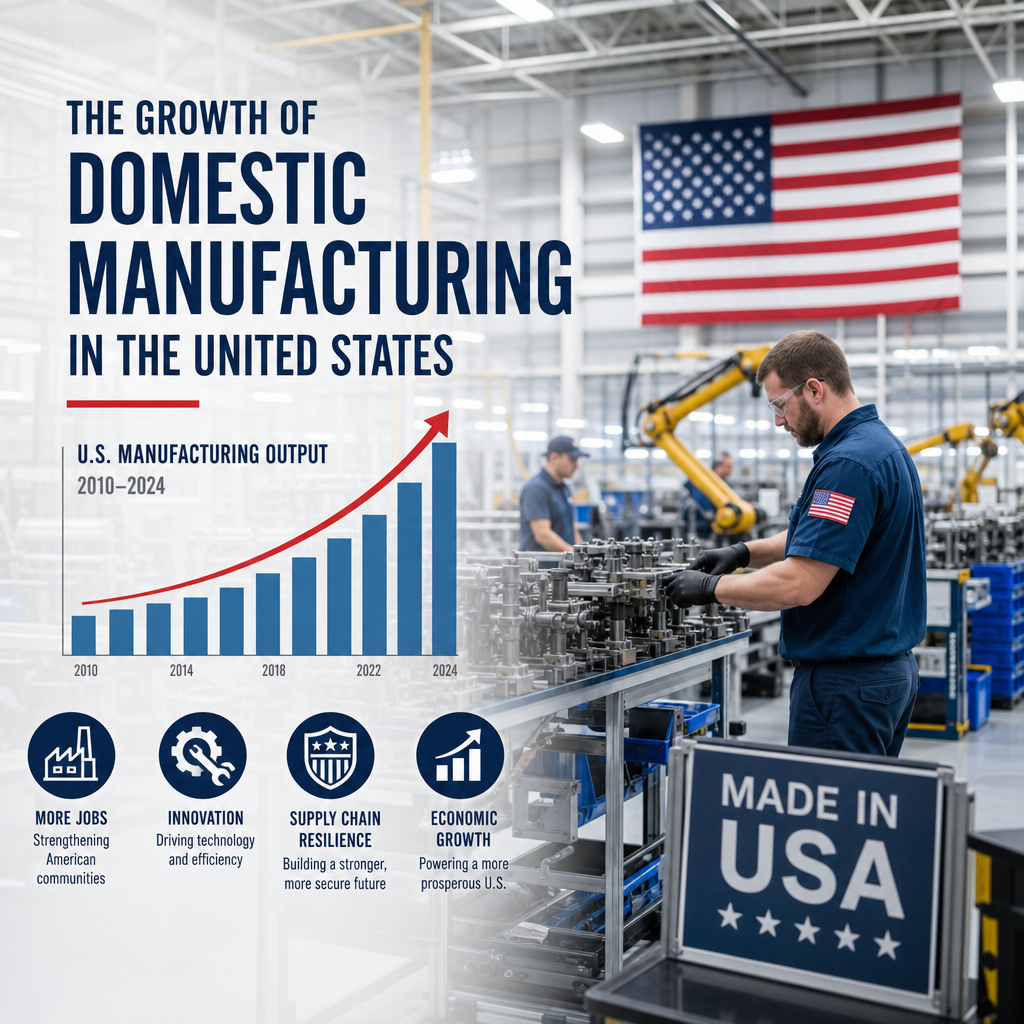
The Growth of Domestic Manufacturing in the United States
Domestic manufacturing is gaining momentum in the United States as companies respond to supply chain shocks, new incentives, and growing demand for resilient production. From advanced tech to everyday goods, the shift is reshaping how American businesses think about making products at home.
By: Peter B on July 25, 2026
Domestic manufacturing in the United States is having a moment. After years of outsourcing, supply chain disruptions, and rising interest in economic resilience, more companies are reconsidering where and how they produce goods. The growth of domestic manufacturing in the United States is not just a policy talking point—it is a real shift driven by business strategy, consumer demand, technology, and national priorities.
From semiconductor plants and electric vehicle batteries to food processing and industrial equipment, American factories are expanding, modernizing, and adapting. This movement reflects a broader effort to strengthen supply chains, create skilled jobs, and support long-term economic stability.
In this article, we’ll explore why domestic manufacturing is growing, what industries are leading the way, the benefits and challenges involved, and what the future may hold.
Why Domestic Manufacturing in the United States Is Growing
The growth of domestic manufacturing in the United States did not happen overnight. It is the result of several converging forces that have changed how businesses think about production.
Supply chain disruptions changed business priorities
The COVID-19 pandemic exposed vulnerabilities in global supply chains. Delays in shipping, shortages of critical components, and unpredictable international logistics forced many companies to rethink dependence on overseas suppliers.
Businesses began to prioritize:
Shorter lead times
Greater supply chain visibility
Reduced transportation risk
More flexible inventory planning
For many manufacturers, producing closer to customers became a strategic advantage, not just a patriotic choice.
Government policy is encouraging investment
Federal and state governments have introduced incentives to support U.S.-based production. These include tax credits, grants, workforce development programs, and infrastructure investments designed to make domestic production more competitive.
While each program has different goals, the common theme is clear: policymakers want to encourage manufacturing in the United States by making it easier and more attractive for companies to invest locally.
Consumer preference matters
Many consumers now value products made in America. For some buyers, domestic production signals quality, faster delivery, and support for local jobs. In categories like home goods, apparel, and food, “Made in USA” labeling can influence purchasing decisions.
This consumer interest has helped strengthen demand for domestic manufacturing in the United States across a range of industries.
Key Industries Driving the Expansion
Not every sector is growing at the same pace, but several industries are at the center of this manufacturing shift.
Semiconductors and advanced electronics
Semiconductors are essential to modern life. They power phones, vehicles, medical devices, and defense systems. Because chip shortages created major disruptions in recent years, companies and policymakers have made domestic chip production a top priority.
New fabrication facilities, often called fabs, are being built or expanded in the U.S. to improve supply chain security and reduce dependence on overseas production.
Automotive and electric vehicles
The auto industry is one of the most visible examples of domestic manufacturing growth. Automakers are investing in U.S. assembly plants, battery manufacturing, and component production as electric vehicles become more common.
This shift is especially important because EVs require new supply chains for batteries, power electronics, and charging infrastructure. That creates opportunities for domestic manufacturers across multiple tiers of production.
Pharmaceuticals and medical supplies
The pandemic also highlighted the risks of relying too heavily on foreign sources for essential medicines and medical equipment. In response, some pharmaceutical firms and medical product manufacturers have increased U.S. production capacity.
This trend supports public health preparedness and helps reduce dependency on fragile global supply chains.
Food and beverage processing
Food manufacturing has long been a major part of the U.S. industrial base. Today, many companies are expanding domestic facilities to improve freshness, cut shipping costs, and better serve regional markets.
Local processing can also support traceability and quality control, which are especially important in packaged foods, beverages, and specialty products.
Industrial machinery and equipment
Domestic production of machinery, tools, and industrial components is also gaining momentum. These products are often essential inputs for other sectors, so strengthening this part of the manufacturing base can have ripple effects throughout the economy.
The Benefits of Domestic Manufacturing
The growth of domestic manufacturing in the United States offers advantages that go beyond simply bringing production home.
Stronger supply chain resilience
When manufacturing happens closer to the end customer, companies can respond more quickly to disruptions. Domestic production helps reduce the risks associated with port delays, shipping bottlenecks, geopolitical tensions, and long-distance transportation.
A more resilient supply chain can mean:
Faster restocking
Better inventory control
Lower exposure to foreign trade disruptions
Greater reliability for critical goods
Job creation and workforce development
Manufacturing jobs have historically played a major role in the U.S. economy. Expanding domestic production creates opportunities not only on the factory floor, but also in logistics, maintenance, engineering, quality assurance, and management.
It also encourages investment in workforce training, apprenticeships, and technical education. In many communities, manufacturing can provide stable career paths with room for advancement.
Faster innovation cycles
When design teams, production facilities, and quality control operations are located in the same country—or even the same region—companies can move more quickly from concept to production.
This can improve:
Product iteration
Communication between departments
Testing and quality feedback
Speed to market
For industries with rapidly changing technology, this agility matters a great deal.
Economic and community impact
Manufacturing plants often bring broader local benefits. They create demand for suppliers, contractors, transportation providers, and service businesses. That can strengthen regional economies and support long-term community growth.
When a factory opens or expands, the impact usually extends well beyond the facility itself.
Challenges Facing Domestic Manufacturing
Even with strong momentum, domestic manufacturing in the United States still faces serious obstacles. Understanding these challenges is important for any realistic assessment of the sector.
Labor shortages and skills gaps
One of the biggest issues is finding enough workers with the right skills. Modern manufacturing often relies on automation, data systems, robotics, and precision equipment. That means employers need technicians, operators, engineers, and maintenance professionals who can work with advanced tools.
Many companies struggle to fill these roles, especially in regions where the talent pipeline has not kept pace with industry demand.
Higher operating costs
Domestic manufacturing can be more expensive than overseas production, especially when labor, compliance, utilities, and real estate costs are considered. Companies must balance these expenses against the benefits of local production.
To stay competitive, many manufacturers focus on:
Automation
Process efficiency
Lean operations
Higher-value products
Stronger quality control
Infrastructure needs
Factories depend on reliable transportation networks, broadband connectivity, energy access, and industrial zoning. In some areas, aging infrastructure can slow development or limit expansion.
To support manufacturing growth, communities need roads, rail access, ports, power systems, and water resources that can handle industrial demand.
Regulatory complexity
Manufacturing businesses often face a wide range of regulations covering safety, environmental compliance, labor, and product standards. These rules serve important purposes, but navigating them can be time-consuming and costly.
A successful domestic manufacturing strategy usually depends on balancing compliance with efficiency and clear planning.
Technology Is Reshaping American Factories
One reason the growth of domestic manufacturing in the United States is more viable today than it was years ago is technology. Modern factories look very different from older industrial plants.
Automation and robotics
Automation helps manufacturers reduce repetitive manual tasks, improve consistency, and increase productivity. Robots are now used in welding, packaging, material handling, and inspection.
This does not mean people are being replaced across the board. Instead, automation often changes the type of work humans do, shifting them toward supervision, programming, maintenance, and problem-solving.
Data and smart manufacturing
Many U.S. manufacturers now use sensors, cloud platforms, and analytics tools to monitor production in real time. This approach, often called smart manufacturing or Industry 4.0, helps companies identify problems early, reduce waste, and optimize equipment performance.
Examples include:
Predictive maintenance alerts
Real-time quality monitoring
Inventory tracking systems
Digital twins for process simulation
Additive manufacturing
3D printing is becoming an important tool for prototyping, tooling, and even some end-use parts. While it is not a replacement for large-scale manufacturing, additive manufacturing can speed product development and enable more customized production.
What Businesses Should Consider Before Reshoring
Reshoring, or bringing production back to the United States, is not automatically the best move for every company. Businesses need to evaluate several practical factors before making the switch.
Total cost, not just labor cost
A common mistake is comparing wages alone. Smart manufacturers look at the full picture:
Transportation expenses
Lead times
Inventory carrying costs
Tariffs or trade risks
Quality issues
Customer expectations
In some cases, domestic production becomes more cost-effective once all these variables are included.
Supplier ecosystem
A factory is only as strong as the network around it. Companies need reliable suppliers for raw materials, packaging, parts, and maintenance. Reshoring can work best in regions where industrial clusters already exist or where supplier networks can grow alongside the primary facility.
Workforce availability
Before expanding domestic manufacturing, businesses should assess whether local labor markets can support the operation. If not, they may need to invest in recruitment partnerships, apprenticeships, and training programs.
Production flexibility
Some firms choose a hybrid model. They may keep some production overseas while moving key products, critical components, or final assembly to the U.S. This approach can provide a balance of cost efficiency and resilience.
How Communities Can Support Manufacturing Growth
Local and regional leaders have an important role in supporting domestic manufacturing in the United States.
Invest in workforce training
Community colleges, trade schools, and apprenticeship programs can help prepare workers for modern manufacturing careers. Training should reflect the realities of today’s industry, including automation, machine operation, and quality systems.
Improve industrial infrastructure
Communities that want to attract manufacturing should pay attention to roads, utilities, broadband, zoning, and permitting processes. A strong industrial base needs physical and digital infrastructure that works reliably.
Strengthen business partnerships
Economic development organizations, workforce boards, and local employers can collaborate to build stronger manufacturing ecosystems. These partnerships help connect talent with opportunity and ensure that new investments can succeed long term.
The Future of Domestic Manufacturing in the United States
The future of domestic manufacturing in the United States will likely be shaped by a mix of resilience, technology, policy, and market demand. The trend is not about returning to an old industrial model. It is about building a more adaptable, innovative, and strategically secure manufacturing base.
In the years ahead, we can expect to see:
More advanced automation in factories
Increased investment in critical industries
Greater emphasis on workforce training
Smarter supply chain design
Continued growth in regional manufacturing hubs
Not every product will be made in America, and that is not the goal. But for many essential goods and high-value products, domestic production is becoming increasingly attractive.
Frequently Asked Questions
1. What does domestic manufacturing in the United States mean?
Domestic manufacturing in the United States refers to goods that are produced, assembled, or significantly transformed within the country. Depending on the product and labeling rules, “Made in USA” can have specific legal requirements.
2. Why are companies bringing manufacturing back to the U.S.?
Companies are reshoring production to reduce supply chain risks, improve delivery times, respond to consumer demand, and take advantage of government incentives. Many also want greater control over quality and production schedules.
3. Is domestic manufacturing always more expensive?
Not always. While labor costs can be higher in the U.S., businesses may save money through lower shipping expenses, shorter lead times, fewer disruptions, and better quality control. The total cost of production matters more than labor alone.
4. Which industries are growing the fastest in domestic manufacturing?
Semiconductors, electric vehicles, pharmaceuticals, medical supplies, food processing, and industrial machinery are among the most active sectors. These industries are responding to both market demand and supply chain concerns.
5. How does domestic manufacturing benefit local communities?
Manufacturing can create jobs, support supplier networks, stimulate local spending, and encourage workforce development. It often has a multiplier effect that benefits nearby businesses and public services.
The growth of domestic manufacturing in the United States reflects a major economic and strategic shift. Businesses are rethinking where they build, assemble, and source products because resilience now matters as much as cost. Supply chain disruptions, evolving consumer expectations, government incentives, and advances in automation have all helped push manufacturing back onto U.S. soil.
This growth brings real benefits: stronger supply chains, more skilled jobs, faster innovation, and deeper community investment. At the same time, it requires serious attention to workforce development, infrastructure, and long-term competitiveness. Domestic manufacturing works best when companies, governments, and local communities plan carefully and invest with purpose.
For business leaders, policymakers, and workers alike, the message is clear: American manufacturing is not simply surviving—it is evolving. Whether you are exploring reshoring, tracking industrial trends, or looking for opportunities in the sector, now is a smart time to pay attention and learn more. The next chapter of U.S. manufacturing is already being written, and it will shape the economy for years to come.
Peter B holds a degree in Journalism and has 5 years of experience covering U.S. economic policy, labor markets, and financial news. He writes data-driven news content on topics like inflation, interest rates, and employment trends.