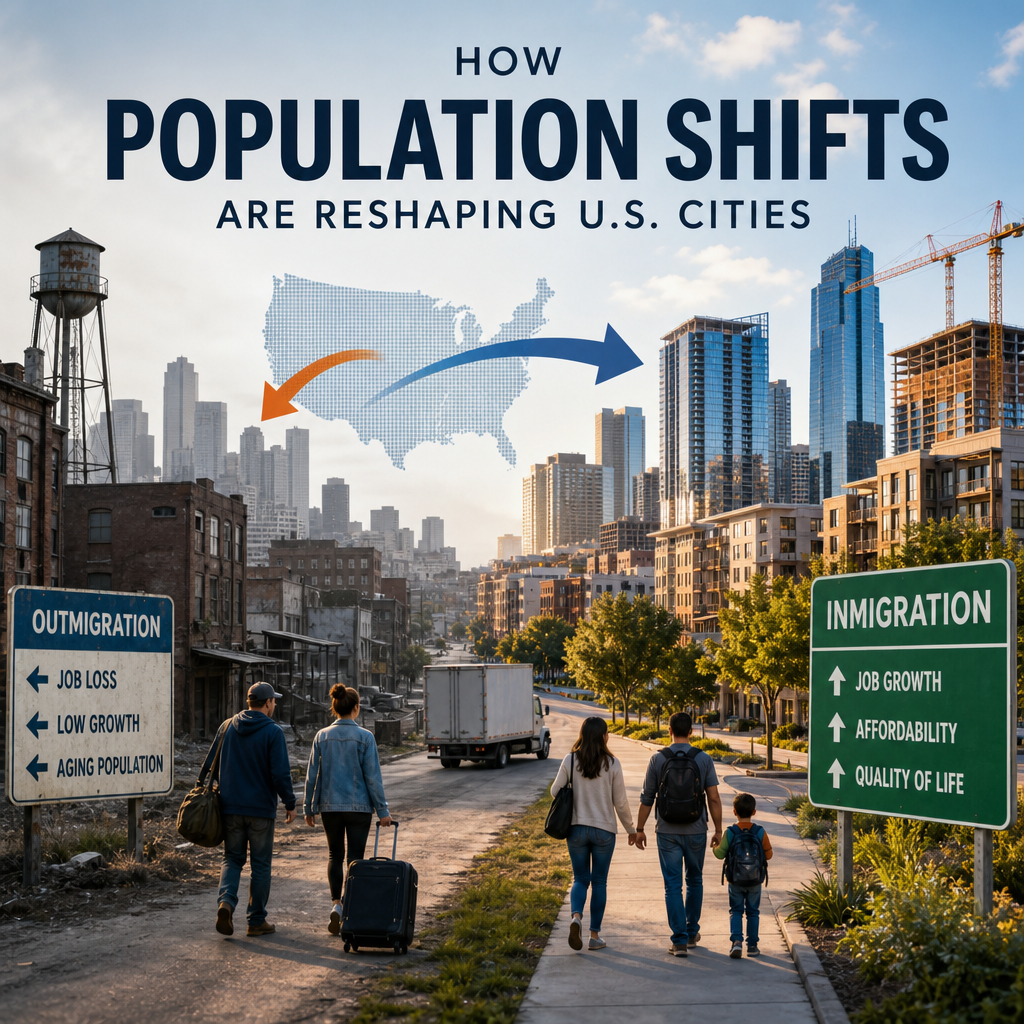
Population shifts are changing the map of American cities, influencing everything from housing and transit to schools and local jobs. As people move for affordability, flexibility, and quality of life, cities must adapt to stay vibrant and resilient.
By: Peter B on July 25, 2026
How Population Shifts Are Reshaping Cities Across the United States
Population change is never just a number on a chart. It affects where homes are built, which schools grow or shrink, how roads and transit systems function, and what kinds of jobs a city can support. Across the country, population shifts are reshaping cities in visible and lasting ways. Some metros are absorbing new residents at a rapid pace, while others are adapting to slower growth, aging populations, or outmigration.
These changes are influencing everything from housing affordability to downtown development and public services. For city leaders, businesses, and residents, understanding population shifts is no longer optional. It is essential for planning a city that can stay livable, competitive, and resilient.
What Population Shifts Mean for Cities
Population shifts refer to changes in where people live and how communities grow over time. In the U.S., these shifts are driven by a mix of factors:
Job opportunities
Housing costs
Climate and weather patterns
Retirement trends
Remote work
Immigration
Birth rates and aging populations
When these forces change, cities change with them. A city that once attracted young workers may now be losing them to more affordable suburbs or smaller metros. Another city may be welcoming families and remote professionals who want more space and lower costs. In either case, local systems must adjust.
Why Population Shifts Are Accelerating
The pace of population shifts has increased because multiple trends are happening at the same time. The rise of remote and hybrid work has loosened the connection between jobs and geography. At the same time, housing affordability pressures are pushing people away from expensive coastal markets and into lower-cost regions.
Housing Costs Are Changing Where People Live
In many large metros, high rents and home prices have made it harder for middle-income households to stay. As a result, people are moving to:
Nearby suburbs
Secondary cities
Fast-growing Sun Belt metros
Smaller regional hubs
This does not always mean people are leaving a state entirely. Often, they are simply shifting within a metro area or from one part of a state to another.
Aging Populations Are Redrawing Demand
Many cities also face a growing share of older adults. That changes what communities need. Older residents may want walkable neighborhoods, healthcare access, and smaller homes. Cities with aging populations often see slower school enrollment growth but higher demand for accessible housing and medical services.
Climate Concerns Are Influencing Migration
Wildfires, hurricanes, heat, drought, and flooding are also affecting where people choose to live. Some households are moving away from areas with repeated climate risks, while others are relocating to places they view as more stable or affordable. These moves are gradual, but they are important in the long-term story of urban growth.
How Population Shifts Are Reshaping Cities Across the United States
The impact of population shifts shows up in nearly every part of urban life. Cities are not only growing or shrinking; they are changing in composition, age, density, and demand.
Housing Markets Are Under Pressure
One of the clearest effects is on housing. When a city gains residents faster than it can add housing, prices usually rise. When a city loses residents or households become smaller, older homes may sit vacant longer or need to be repurposed.
Cities are responding by:
Updating zoning rules to allow more housing types
Encouraging infill development on underused land
Converting vacant office space into residential use
Expanding affordable housing programs
For example, a growing city may need more apartments near transit. A slower-growth city may need strategies to renovate aging housing stock and prevent neighborhood decline.
Transportation Systems Must Adapt
Population changes also affect how people move around. Growing cities may experience more traffic, packed transit lines, and pressure for new infrastructure. Shrinking cities may have underused roads and transit systems that are too expensive to maintain at previous levels.
This creates a planning challenge. Cities need to match transportation investments with actual demand. That might mean:
Expanding bus service in growing corridors
Improving sidewalks and bike networks
Prioritizing maintenance over new highway expansion
Designing transit routes around changing commute patterns
Remote work has made this even more complex. Some downtown routes now carry fewer commuters on weekdays, while suburban routes and neighborhood services may need more attention.
Schools and Family Services Are Shifting Too
Population shifts affect school enrollment, childcare demand, and youth programming. Neighborhoods with an influx of young families may need more classrooms and teachers. Areas with fewer children may need to consolidate schools or repurpose empty buildings.
This can be difficult for communities because schools often anchor local identity. But planning ahead helps avoid rushed decisions and service gaps.
Cities and school districts often need to coordinate on:
Enrollment projections
Building upgrades
Safe walking routes
Access to after-school programs
Multi-use public facilities
Workforce Needs Are Evolving
Cities depend on their labor force just as much as their physical infrastructure. When population growth slows or the age mix changes, employers may struggle to fill jobs. In some metros, especially those losing younger workers, businesses face talent shortages in healthcare, education, hospitality, and construction.
In response, cities are trying to retain workers by improving quality of life. That can include:
More affordable housing
Better transit access
Safer streets
Faster permitting for small businesses
Stronger local training programs
A city that wants to stay competitive must think not only about attracting people, but also about keeping them.
The Rise of Sun Belt and Secondary Cities
One of the most important stories in population shifts is the growth of Sun Belt and secondary cities. Places such as Phoenix, Austin, Raleigh, Nashville, Tampa, and many others have drawn new residents for decades. Some are expanding because of job growth. Others are benefiting from lower costs, warmer climates, and business-friendly reputations.
At the same time, many smaller metros are gaining attention as alternatives to the largest and most expensive cities. These places often offer:
Lower housing costs
Less congestion
Shorter commutes
Strong local identity
More space for families and businesses
However, rapid growth brings tradeoffs. Infrastructure can lag behind demand. Traffic worsens. Water and energy systems may face stress. And if growth outpaces planning, affordability can deteriorate quickly.
Cities Losing Population Are Not Standing Still
When people think about population shifts, they often focus on fast-growing cities. But places losing residents are also being reshaped in important ways. Some older industrial cities and rural-linked metros are dealing with population decline, aging infrastructure, and fiscal pressure.
That does not mean decline is inevitable or irreversible. Many cities are finding ways to stabilize or reinvent themselves by focusing on:
Neighborhood revitalization
Arts and culture
Higher education
Healthcare and research industries
Historic preservation
Adaptive reuse of vacant buildings
For these cities, the goal is often not to return to a previous peak. Instead, it is to build a sustainable future based on current realities.
Right-Sizing Public Services
A city with fewer residents may need to rethink how it delivers services. This can include:
Consolidating underused facilities
Improving maintenance budgets
Revising transit routes
Targeting investment in stronger neighborhoods
Supporting vacant property redevelopment
These decisions are often politically difficult, but they are necessary when tax bases and population levels no longer match older assumptions.
How Migration Is Changing Neighborhoods
Migration patterns do not affect all parts of a city equally. Even within the same metro area, one neighborhood may gain residents while another loses them. This creates new tensions and opportunities.
New Residents Bring New Demand
An influx of residents can breathe life into neighborhoods that once struggled. Vacant stores may reopen. Local schools may stabilize. Parks and transit stops may get more use. In some cases, new residents help support small businesses and public investment.
But Rapid Change Can Also Displace Longtime Residents
When demand rises too quickly, longtime residents may face higher rents, property taxes, and changing neighborhood character. That is why smart planning matters. Cities need to balance growth with affordability and community stability.
Useful tools include:
Inclusionary zoning
Property tax relief for vulnerable homeowners
Tenant protections
Community land trusts
Preservation of naturally affordable housing
These strategies help cities grow without pushing out the people who helped build them.
Data and Planning Matter More Than Ever
To respond well to population shifts, cities need accurate, up-to-date data. Census counts, local housing surveys, school enrollment trends, and labor market information all help leaders understand what is changing.
Good planning requires asking practical questions:
Where is growth happening?
Which neighborhoods are aging fastest?
Are new residents renting or buying?
Do schools and roads match projected demand?
Which services are overbuilt or underprovided?
Cities that rely on outdated assumptions often waste money or miss opportunities. Data-driven planning helps communities adapt faster and more fairly.
Practical Examples of City Responses
Many cities are already adjusting in response to population shifts. While each place is different, a few patterns stand out.
Growing Cities Are Adding Density
Fast-growing cities are often changing zoning to allow:
Duplexes and triplexes
Accessory dwelling units
Mixed-use buildings
Transit-oriented development
These changes can expand housing supply without forcing endless sprawl.
Slower-Growth Cities Are Reusing Space
Cities with vacant office towers, empty school buildings, or underused industrial sites are finding new uses for old spaces. Common examples include:
Converting offices to housing
Turning old factories into mixed-use districts
Reopening vacant lots as parks or community gardens
Repurposing schools for civic or nonprofit use
Some Suburbs Are Becoming Urban Centers
Not all change is happening in central cities. Inner suburbs are also evolving as households seek more walkable, connected neighborhoods. These places may add apartments, retail, and transit links to better serve changing demographics.
What Residents Should Watch For
Population shifts affect daily life in ways people can see and feel. If you live in a changing city, pay attention to:
New housing construction or lack of it
School crowding or closures
Transit service changes
Rising rents or property taxes
Vacant commercial spaces
Infrastructure repairs and upgrades
New businesses and neighborhood turnover
These are signals that the city is evolving. They can reveal whether local leaders are planning ahead or reacting too late.
Frequently Asked Questions
What are population shifts in urban areas?
Population shifts are changes in where people live, how many people live in a place, and who those people are. In cities, this may include growth, decline, aging, migration, or changes in household size. These shifts affect housing, transportation, schools, and public services.
Why are population shifts important for city planning?
Population shifts shape demand for housing, roads, transit, utilities, and schools. If city leaders do not track those changes, they may build too little, too much, or in the wrong places. Good planning helps cities use resources wisely and stay adaptable.
Which U.S. cities are growing the fastest?
Fast-growing cities are often found in the Sun Belt and in selected secondary metros. Growth patterns change over time, so it is best to check current Census and local data rather than rely on general assumptions. Factors like housing affordability, job growth, and climate play a major role.
How do population shifts affect housing prices?
When more people move into a city than new housing is added, prices usually rise. If a city loses residents or builds more housing than demand requires, prices may stabilize or even fall in some areas. Local zoning, construction rates, and income levels all influence the outcome.
Can cities that are losing population recover?
Yes, but recovery usually looks different than simple growth. Cities can stabilize by improving neighborhoods, attracting investment, supporting local jobs, and repurposing vacant buildings. Success often depends on realistic planning and long-term community commitment.
Population change is reshaping American cities in ways that reach far beyond city limits. From housing shortages in fast-growing metros to service consolidation in slower-growth places, population shifts are influencing how communities build, move, learn, and work. The cities that respond best are the ones that treat change as a planning reality, not a temporary disruption.
That means using data to guide decisions, investing in housing that matches local demand, aligning transportation with new travel patterns, and protecting the stability of existing neighborhoods. It also means recognizing that growth and decline are not the only stories. Many cities are doing both at once, with some neighborhoods booming while others struggle to keep pace.
For residents, business owners, and policymakers, the key is to stay informed and engaged. Cities that understand their changing populations can make smarter choices today and build stronger communities for tomorrow.
Peter B holds a degree in Journalism and has 5 years of experience covering U.S. economic policy, labor markets, and financial news. He writes data-driven news content on topics like inflation, interest rates, and employment trends.