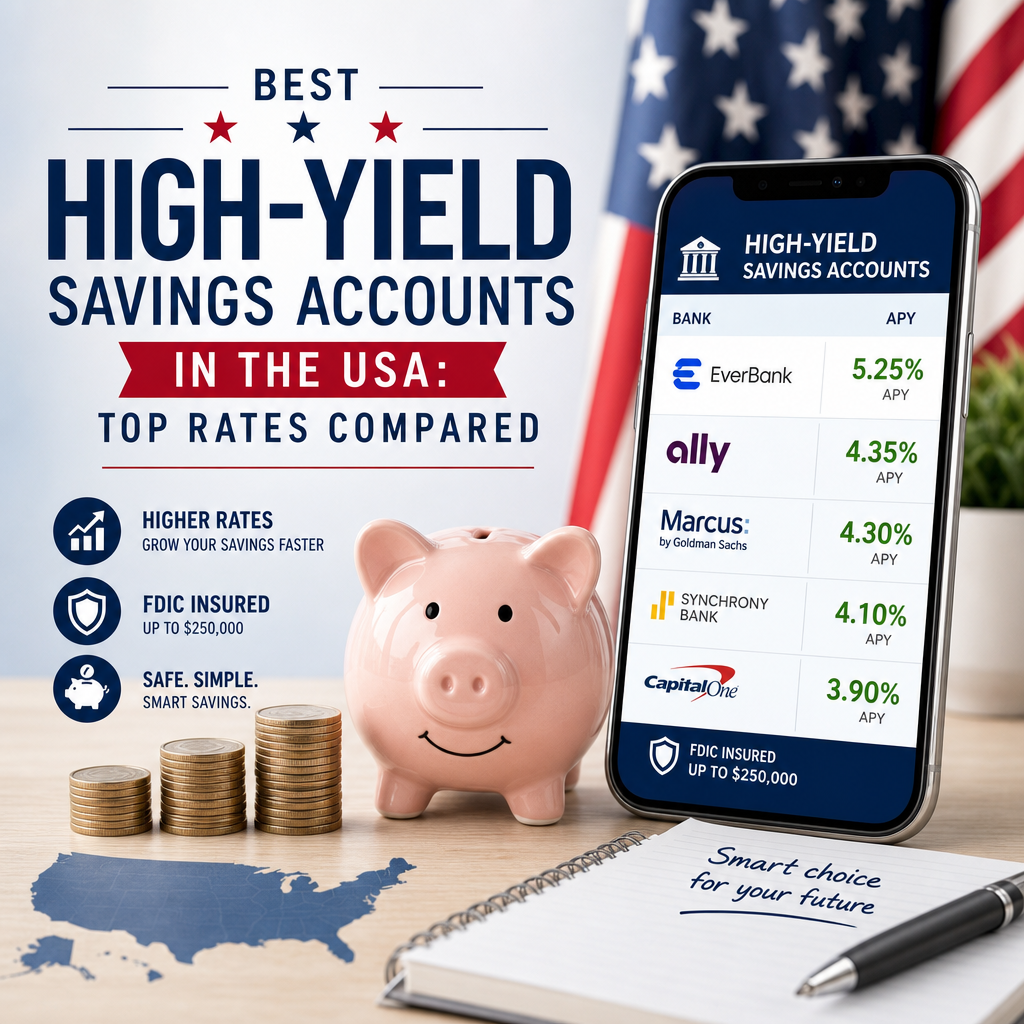
Best High-Yield Savings Accounts in the USA: Top Rates Compared
Looking for a safe, flexible way to grow your cash? High-yield savings accounts can offer competitive APYs, low fees, and easy access to your money, making them a smart choice for emergency funds and short-term savings goals.
By: Mary Mitchell on July 24, 2026
Best High-Yield Savings Accounts in the USA: Compare Top Rates and Features
If you’re looking for a safe place to park your cash while earning more than a traditional savings account usually offers, the best high-yield savings accounts in the USA can be a smart choice. These accounts combine accessibility, low risk, and competitive annual percentage yields (APYs), making them useful for emergency funds, short-term goals, and cash you want to keep liquid.
But not all high-yield savings accounts are created equal. Some stand out for a consistently strong APY, while others win on no monthly fees, easy transfers, ATM access, or a user-friendly mobile app. The best account for you depends on how you plan to use your money.
In this guide, we’ll compare key features, explain what to look for, and help you narrow down the best high-yield savings accounts in the USA for your needs.
What Is a High-Yield Savings Account?
A high-yield savings account is a savings account that typically pays a much higher interest rate than a standard brick-and-mortar bank savings account. Most are offered by online banks or credit unions, which often have lower overhead and can pass those savings on to customers through better APYs.
Why people choose high-yield savings accounts
High-yield savings accounts are popular because they offer:
Easy access to your money
Federal deposit insurance, when held at an insured institution
No market risk, unlike stocks or mutual funds
A simple way to earn interest on cash reserves
These accounts are especially useful for:
Emergency funds
Vacation savings
Home repair funds
Car replacement savings
Down payment money you may need within a few years
Best High-Yield Savings Accounts in the USA: What to Compare
When comparing the best high-yield savings accounts in the USA, don’t focus on APY alone. A slightly lower rate may still be the better deal if the account has fewer restrictions or better features.
1. APY and rate consistency
The APY tells you how much interest you can earn in a year, including compounding. Since rates can change, look for accounts with a strong track record of staying competitive rather than just a one-time promo rate.
2. Minimum opening deposit
Some accounts require no opening deposit, while others may ask for $100, $500, or more. If you’re starting small, a low or zero minimum matters.
3. Monthly fees
A savings account should help your money grow, not eat into it. Look for accounts with:
No monthly maintenance fee
No paper statement fee, if possible
No excess withdrawal penalties for normal use
4. Access to your money
Consider how easily you can move money in and out of the account. Good features include:
Fast ACH transfers
External bank linking
Mobile check deposit
ATM access, if offered
Same-day or next-day transfers
5. FDIC or NCUA insurance
Make sure the institution is insured. Most banks are FDIC-insured, and credit unions are usually insured by the NCUA. That coverage helps protect your deposits up to applicable limits.
6. Customer experience and mobile tools
The best rate matters less if the app is clunky or support is hard to reach. Look for:
Strong app ratings
Easy account setup
Clear transaction history
Responsive customer service
Helpful budgeting or savings tools
Best High-Yield Savings Accounts in the USA: Top Features to Look For
Below are the main types of accounts and features that often make them stand out. Because rates change frequently, it’s smart to confirm current APYs directly on the provider’s site before opening an account.
Best for overall value
An account that balances a strong APY with no monthly fees, no minimum balance requirement, and easy transfers often offers the best overall value. This is ideal if you want a no-fuss place to grow an emergency fund.
Best for easy access
If you want to use your savings as a flexible cash reserve, prioritize:
Same-day transfer options
ATM availability
Debit card access
Fast external transfers
This setup can be helpful for freelancers, variable-income households, or anyone managing cash flow.
Best for goal-based saving
Some banks make it easy to organize multiple savings buckets. If you like to separate your money for different purposes—like travel, taxes, and emergencies—look for accounts that support:
Multiple savings “sub-accounts”
Automatic round-ups
Scheduled transfers
Savings goal tracking
Best for paired checking and savings
Some banks offer a strong checking and savings bundle. That can simplify money management if you want to keep everything in one place. These accounts may include:
Internal transfers
Bill pay
Debit card access
Fee waivers for maintaining both accounts
How to Choose the Right High-Yield Savings Account
Choosing from the best high-yield savings accounts in the USA starts with understanding your priorities. Here’s a simple way to decide.
Step 1: Define your purpose
Ask yourself what the money is for.
Emergency fund: prioritize safety, easy access, and no fees
Short-term savings: prioritize APY and transfer speed
Goal-based savings: prioritize budgeting tools and automation
Cash reserve: prioritize liquidity and simplicity
Step 2: Estimate how often you’ll move money
If you transfer funds often, a bank with smooth mobile features and fast external transfers may be more useful than one with the highest APY. If you plan to leave the money untouched, rate becomes more important.
Step 3: Check the fine print
Look beyond the headline rate. Read the account details for:
Variable rate disclosures
Transfer limits
Fee schedules
Minimum balance requirements
Withdrawal timing rules
Step 4: Compare usability
An account should fit your daily habits. If you mostly bank on your phone, choose a provider with strong digital tools. If you prefer in-person help, a local bank or credit union may be worth a slightly lower APY.
Online Banks vs. Traditional Banks
Many of the best high-yield savings accounts in the USA are offered by online banks. That doesn’t mean traditional banks are always a bad choice—it just means online banks often have a cost advantage.
Online banks
Pros:
Usually higher APYs
Lower fees
Strong digital tools
Easy account opening
Cons:
No physical branches
Cash deposits can be more difficult
Customer service is mostly remote
Traditional banks
Pros:
Branch access
In-person support
Easier cash handling
Convenient if you already bank there
Cons:
Lower APYs are common
More fees in some cases
Fewer standout savings features
Credit unions
Credit unions can also offer excellent savings accounts, sometimes with competitive rates and a member-focused approach. If you value service and community connection, a credit union may be a strong option.
Common Mistakes to Avoid
Even a strong savings account can disappoint if you overlook the details.
Chasing a teaser rate
Some accounts advertise a high introductory APY that drops later. Make sure you know whether the rate is promotional or ongoing.
Ignoring fees
A monthly fee can quickly reduce your earnings, especially on smaller balances. Always confirm that the account is truly low-cost.
Overlooking access limits
Some savings accounts limit transfers or take longer than expected for withdrawals. If you might need the cash soon, these details matter.
Not checking insurance
Only use insured financial institutions for money you want protected. Deposit insurance is a key safety feature.
Letting savings sit in the wrong place
If your emergency fund is in a checking account earning nothing, moving it to one of the best high-yield savings accounts in the USA can help your balance work harder without sacrificing liquidity.
Practical Example: How the Right Account Can Help
Imagine you have $10,000 set aside for emergencies. In a basic savings account with a very low rate, that money may earn little over time. In a high-yield savings account, the same balance can earn more interest while still remaining available when you need it.
Now imagine two options:
Account A: slightly higher APY, but it charges a monthly fee
Account B: slightly lower APY, but no fees and instant transfers
For many people, Account B is the better choice because fees and convenience matter just as much as rate. That’s why comparing features is just as important as comparing APYs.
Who Should Use a High-Yield Savings Account?
A high-yield savings account is a strong fit for many people, including:
New savers building an emergency fund
Families saving for upcoming expenses
Freelancers and gig workers managing irregular income
Homebuyers keeping a down payment safe
Anyone with extra cash they may need within 1 to 3 years
If your money is needed soon and you want to avoid investment risk, high-yield savings is often a practical middle ground.
When a High-Yield Savings Account May Not Be Enough
High-yield savings accounts are great for safety and access, but they’re not designed for long-term growth. If your time horizon is longer and you can tolerate risk, you may also consider:
Certificates of deposit for fixed-term savings
Money market accounts for slightly different access features
Investment accounts for long-term goals
The right choice depends on when you’ll need the money and how comfortable you are with risk.
Frequently Asked Questions
1. What makes a high-yield savings account better than a regular savings account?
The main difference is the interest rate. High-yield savings accounts generally offer much better APYs than standard savings accounts, which helps your money grow faster. They also usually keep the same basic benefits of savings accounts, such as liquidity and deposit insurance.
2. Are high-yield savings accounts safe?
Yes, high-yield savings accounts are generally safe as long as they are held at an FDIC-insured bank or an NCUA-insured credit union. That protection covers eligible deposits up to applicable limits. As always, confirm that the institution is properly insured before opening an account.
3. Can I lose money in a high-yield savings account?
You typically do not lose principal in a high-yield savings account, assuming the institution is insured and you stay within coverage limits. However, you can lose value in other ways, such as paying monthly fees or earning less interest than inflation over time.
4. How often do APYs change?
APYs can change at any time because they usually track broader interest rate conditions. Some banks update rates more often than others. It’s a good idea to review your account periodically and compare it with other options if you want to keep earning a competitive return.
5. Is it worth switching banks for a better savings rate?
It can be worth it, especially if you keep a meaningful balance and the new account has no fees or transfer hassles. Even a modest rate difference can matter over time. That said, don’t switch based on APY alone—make sure the new account is easy to use and fits your needs.
The best high-yield savings accounts in the USA do more than offer a strong APY. They combine safety, convenience, low fees, and features that make saving easier in real life. Whether you’re building an emergency fund, saving for a major purchase, or simply trying to make better use of idle cash, the right account can help you stay organized while earning more interest.
Before opening an account, compare the full package: rate, fees, minimum balance requirements, transfer speed, insurance, and digital experience. A slightly lower APY may be the smarter pick if it comes with no monthly fee and better access. The best choice is the one that matches your financial habits and savings goals.
Take a few minutes to review your current savings setup. If your money is sitting in a low-interest account, moving it to a better option could be a simple upgrade with lasting benefits. A thoughtful comparison today can make your savings more efficient for months and years to come.
Mary S, CFP®, is a Certified Financial Planner with over 12 years of experience in personal finance, retirement planning, and wealth management. She writes educational content that helps readers understand financial concepts and make informed decisions based on reliable information.