Personal Loans vs. Credit Cards: Which Is Better?
Personal Loans vs. Credit Cards: Which Option Makes More Financial Sense?
When you need to borrow money, the decision between personal loans vs. credit cards can have a big impact on your budget, your credit, and your long-term financial health. Both options can help you cover expenses, but they work very differently. The right choice depends on how much you need, how quickly you can repay it, and what you’re borrowing for.
If you’re comparing personal loans vs. credit cards, it helps to think beyond the monthly payment. Interest rates, repayment terms, fees, and flexibility all matter. In some situations, a personal loan can save money and simplify repayment. In others, a credit card may be the more practical tool.
Personal Loans vs. Credit Cards: The Core Difference
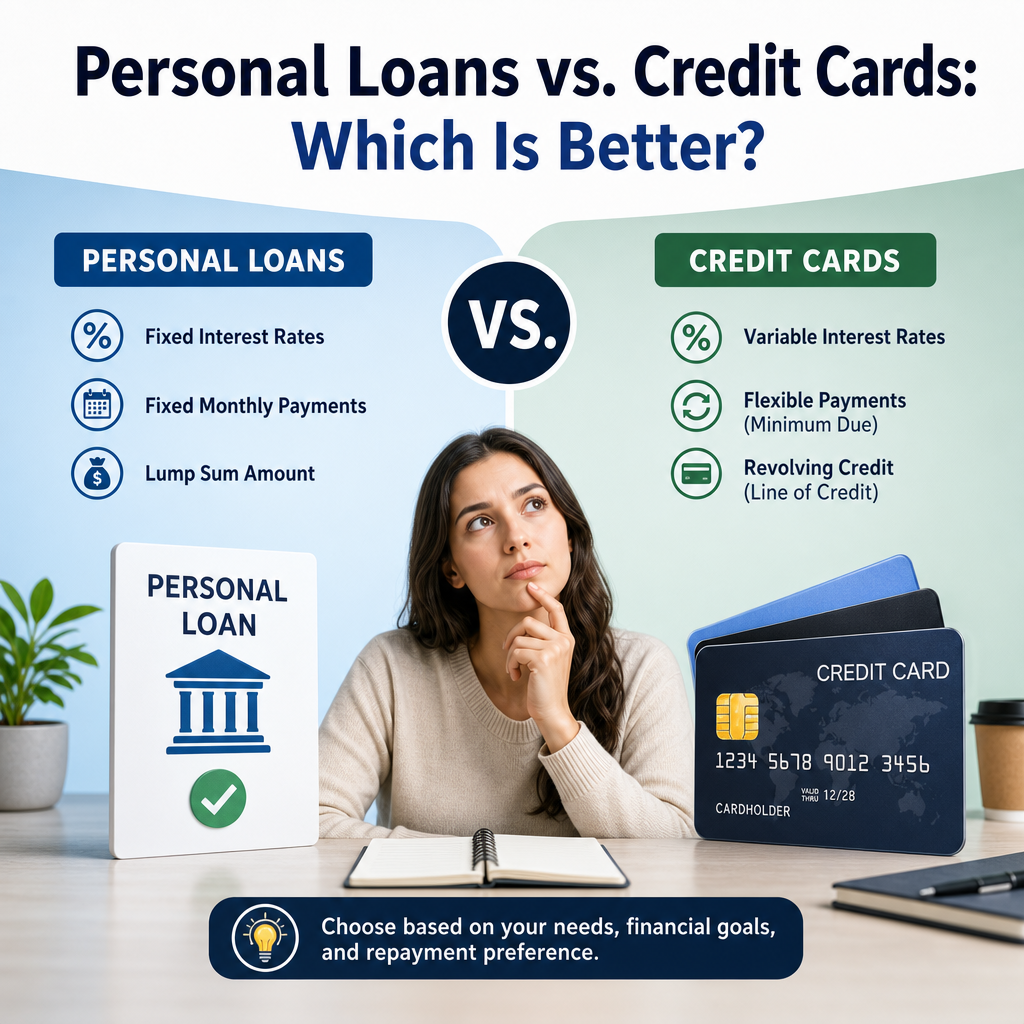
At a basic level, a personal loan gives you a lump sum of money upfront that you repay over a fixed period, usually in equal monthly installments. A credit card gives you a revolving line of credit that you can borrow from repeatedly, as long as you stay within your limit and make minimum payments.
That difference shapes everything else:
- Personal loans are usually best for larger, planned expenses.
- Credit cards are often better for smaller purchases or short-term borrowing.
- Personal loans typically have fixed interest rates and fixed payments.
- Credit cards often have variable rates and flexible payment amounts.
Because of these differences, the cheaper option is not always the most convenient one—and the most convenient option is not always the cheapest.
How Personal Loans Work
A personal loan is installment debt. You borrow a set amount, then repay it over a fixed term, commonly two to seven years. Payments usually stay the same each month, which makes budgeting easier.
Common uses for personal loans
People often use personal loans for:
- Debt consolidation
- Home repairs
- Medical bills
- Major life events
- Emergency expenses
- Large one-time purchases
Why borrowers choose personal loans
A personal loan can make sense when you want:
- Predictable monthly payments
- A set payoff date
- A potentially lower interest rate than a credit card
- A way to combine several debts into one payment
For example, if you have multiple credit card balances with high interest, a personal loan may help you consolidate those debts into one fixed payment and reduce the total interest you pay over time.
How Credit Cards Work
Credit cards are revolving credit. You can borrow, repay, and borrow again up to your credit limit. You only pay interest on the amount you carry from month to month, not on the full limit.
Common uses for credit cards
Credit cards are often used for:
- Everyday spending
- Travel
- Online purchases
- Short-term emergencies
- Small unexpected bills
- Rewards and cash back
Why borrowers choose credit cards
Credit cards offer flexibility. You can charge an expense today and pay it off quickly without applying for a loan. Many cards also offer rewards, purchase protection, and fraud protection.
However, if you carry a balance, interest can add up fast—especially if your card has a high annual percentage rate (APR).
Personal Loans vs. Credit Cards: Which Costs Less?
This is usually the biggest question. In many cases, personal loans vs. credit cards comes down to interest rate and repayment time.
Personal loans may cost less when:
- You need to borrow a larger amount
- You want a structured payoff schedule
- You qualify for a competitive fixed APR
- You plan to repay over more than a few months
Credit cards may cost less when:
- You can pay the balance in full by the due date
- You qualify for a 0% introductory APR offer
- You only need to borrow a small amount briefly
If you carry a credit card balance month after month, the cost can grow quickly. A personal loan often offers a better chance of paying less in interest because the payoff term is fixed and the APR is usually lower than a standard credit card rate.
That said, a 0% intro APR card can be a strong short-term option if you’re disciplined and can repay the balance before the promotional rate ends.
When a Personal Loan Makes More Financial Sense
A personal loan is often the better choice when you want structure and stability. It can also be a smarter move if your goal is to save money on interest.
Best situations for personal loans
1. Debt consolidation
If you’re juggling several high-interest balances, a personal loan can simplify repayment. One monthly payment is easier to manage than several different due dates.
2. Predictable large expenses
For expenses like a wedding, major repair, or medical bill, a loan gives you a defined repayment plan.
3. Lower fixed rate
If the personal loan APR is lower than your credit card APR, borrowing through the loan may reduce your total cost.
4. You need more time to repay
If you need 12 to 60 months or more, a personal loan usually provides a more realistic payoff timeline than revolving credit.
Practical example
Suppose you need $8,000 for a home repair. If you put it on a credit card and only make minimum payments, you could end up paying far more in interest over time. A personal loan with a fixed monthly payment may give you a clearer and potentially cheaper path to repayment.
When a Credit Card Makes More Financial Sense
A credit card can be the better option when convenience matters and the debt will be short-lived.
Best situations for credit cards
1. Small or temporary expenses
If you only need to borrow a modest amount and can pay it off quickly, a credit card may be fine.
2. Emergency purchases you can repay soon
For example, if your car needs an unexpected repair and your next paycheck is close, a card can bridge the gap.
3. 0% APR promotional offers
Some credit cards offer a limited period where you pay no interest on purchases or balance transfers. If you can pay the debt off before the promo ends, this can be a very cost-effective option.
4. You want rewards or protections
If you use a rewards card for purchases you would make anyway—and pay the balance in full each month—you may earn points, miles, or cash back without interest charges.
Practical example
If you charge a $500 vet bill and repay it in full before the due date, you may avoid interest completely. In that case, a credit card is more convenient and may be free to use if managed responsibly.
Interest Rates, Fees, and Terms: What to Compare
To make a smart choice in the personal loans vs. credit cards debate, compare more than just the headline APR.
Look closely at these factors:
- APR: The annual cost of borrowing
- Origination fees: Some personal loans charge an upfront fee
- Late fees: Both loans and cards may charge if you miss a payment
- Balance transfer fees: Common with credit cards
- Repayment term: Longer terms lower monthly payments but may increase total interest
- Variable vs. fixed rate: Credit cards often change over time; personal loan rates are usually fixed
A few rules of thumb
- If you plan to carry a balance, compare the full cost of borrowing.
- Don’t focus only on the monthly payment.
- Read the fine print, especially on promotional credit card offers.
- Make sure you understand what happens after any introductory rate expires.
How Each Option Affects Your Credit
Borrowing can affect your credit score, but personal loans and credit cards can influence it in different ways.
Personal loans and credit
A personal loan can help your credit if you make on-time payments consistently. It also adds installment debt to your credit mix, which can be a positive factor for some borrowers.
However, missing payments can hurt your score, and applying for a new loan may cause a small temporary dip due to the hard inquiry.
Credit cards and credit
Credit cards have a bigger impact on utilization, which is the amount of credit you’re using compared with your total limit. High balances can hurt your score, even if you make payments on time.
Credit cards can help build credit when you:
- Keep balances low
- Pay on time
- Avoid maxing out your limits
Which is better for credit building?
Neither is automatically better. Responsible use matters more than the product itself. But if you tend to overspend, a personal loan may be easier to manage because it doesn’t allow you to keep borrowing after the original amount.
Which Option Is Better for Debt Consolidation?
For many people, debt consolidation is where personal loans vs. credit cards becomes especially important.
Personal loans for consolidation
A personal loan may be the stronger option if:
- Your current card rates are high
- You want one fixed payment
- You need a clear end date
- You’re committed to not adding new card debt
Credit cards for consolidation
A balance transfer credit card can be useful if:
- You qualify for a strong intro APR offer
- You can pay the balance off within the promotional window
- The balance transfer fee is reasonable
- You won’t continue using the old card balance irresponsibly
A balance transfer is not a magic fix. If you miss the promo deadline or continue charging new purchases, you can end up in a worse position.
How to Decide: A Simple Framework
If you’re unsure which option makes more financial sense, use this quick decision process.
Ask yourself these questions:
- How much do I need to borrow?
- How quickly can I repay it?
- What’s the interest rate and fee structure?
- Do I need predictable payments?
- Am I disciplined enough to manage revolving credit?
Choose a personal loan if:
- You need a larger amount
- You want fixed payments
- You want a defined payoff date
- You’re consolidating debt
- The loan APR is lower than your card rate
Choose a credit card if:
- You need short-term flexibility
- The expense is small
- You can pay it off quickly
- You qualify for 0% APR
- You want rewards and protections on purchases
Common Mistakes to Avoid
Borrowing can be helpful, but it can also become expensive if you’re not careful.
Watch out for these mistakes:
- Choosing the lowest monthly payment without checking total cost
- Ignoring fees
- Relying on credit cards for long-term debt
- Using a personal loan to consolidate debt, then racking up new card balances
- Missing payments and damaging your credit
- Assuming a promotional APR will last forever
The best borrowing decision is one that fits both your immediate need and your repayment plan.
Frequently Asked Questions
1. Is a personal loan always cheaper than a credit card?
Not always. A personal loan is often cheaper if you carry a balance for a long time, especially when your credit card APR is high. But if you can pay off a credit card quickly or use a 0% promotional offer, the credit card may cost less.
2. What is the biggest advantage of a personal loan?
The biggest advantage is predictability. You get a fixed amount, a fixed interest rate in most cases, and a fixed repayment schedule. That makes budgeting and payoff planning much easier.
3. When should I use a credit card instead of a personal loan?
A credit card can be a good choice for small, short-term expenses you can repay quickly. It may also make sense if you want rewards, purchase protections, or a 0% introductory APR offer.
4. Can using a personal loan help my credit score?
Yes, if you make on-time payments. A personal loan can help build a positive payment history and diversify your credit mix. But late payments can damage your credit.
5. Is debt consolidation better with a personal loan or credit card?
It depends on your situation. A personal loan is often better for structured, long-term consolidation. A balance transfer credit card may work well for smaller debts if you can repay them during the promotional rate period.
Official Resources
- Consumer Financial Protection Bureau: Personal Loans
- Consumer Financial Protection Bureau: Credit Cards
- Federal Reserve: Consumer Credit
- Federal Trade Commission: Credit, Loans, and Debt
- MyCreditUnion.gov: Borrowing Basics
Conclusion
Choosing between personal loans vs. credit cards comes down to your borrowing goal, your repayment timeline, and the true cost of carrying the debt. A personal loan often makes more financial sense when you need a larger amount, want fixed monthly payments, or are trying to consolidate high-interest debt. A credit card can be the smarter option when the expense is small, temporary, or eligible for a 0% introductory APR—and when you’re confident you can pay it off on time.
The key is to borrow with a clear plan. Compare APRs, fees, repayment terms, and your own spending habits before you decide. If you want predictability and structure, a personal loan may be the better fit. If you need flexibility and can repay quickly, a credit card may work just fine. In either case, the smartest choice is the one that helps you meet your financial goal without creating more debt than you can comfortably manage.